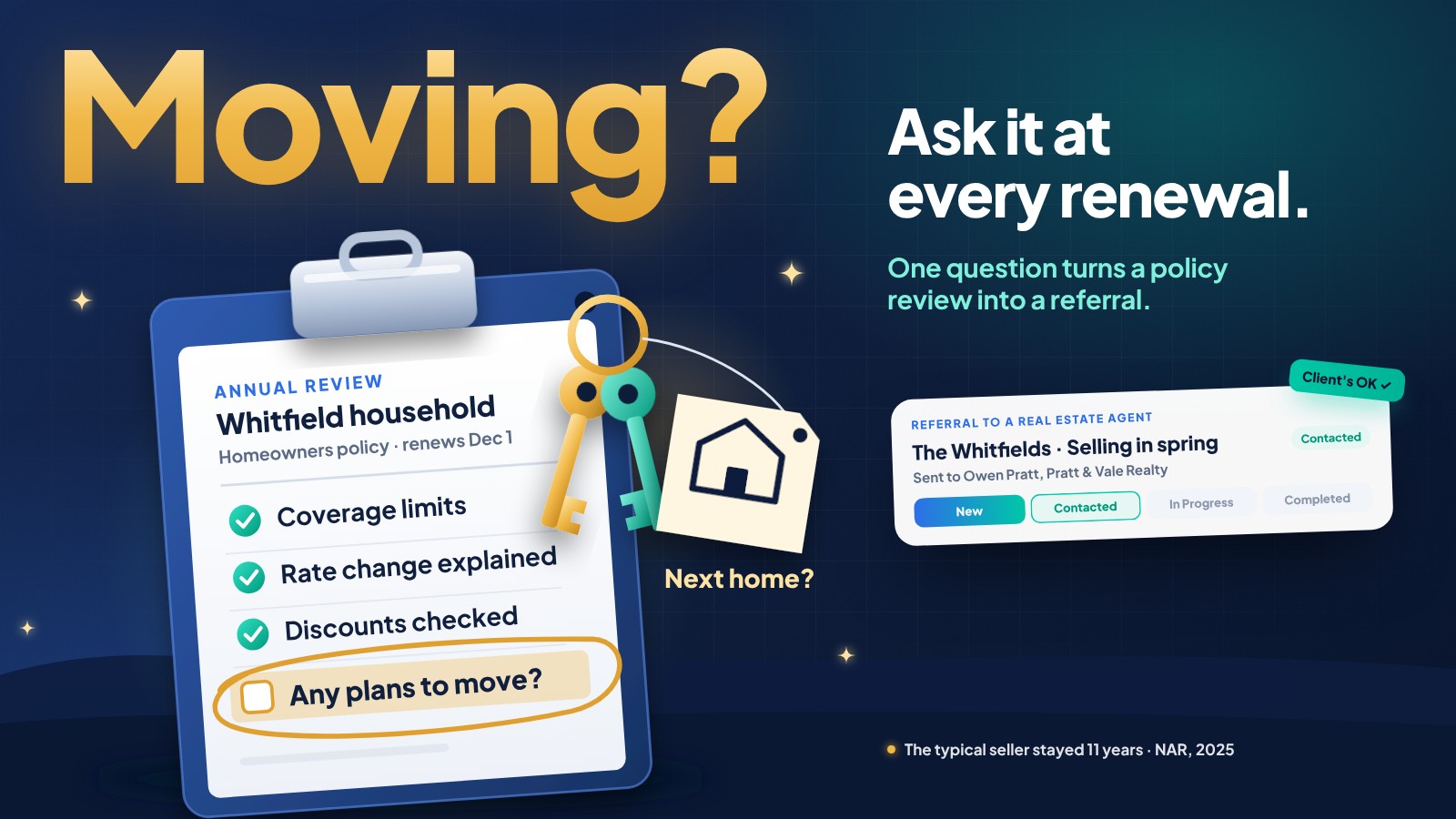
Nadia Fairbanks has the Whitfields on speaker for their annual review. Their homeowners premium went up again, so she walks them through why, checks the discount their new roof should earn, and confirms their coverage still fits the house. Fifteen minutes in, everybody is ready to hang up.
Then she asks one more thing: "Before I let you go, any plans to move in the next year or so?"
A pause. "Funny you ask," Mrs. Whitfield says. "We've started looking at houses closer to my mom."
That pause is worth more than the rest of the call. Months before anyone lists anything, Nadia knows this family will need a real estate agent, a policy on a new home, and probably a lender. Most insurance pros never hear it, because nobody asks.
The call is happening anyway
Rising rates have put insurance pros and their clients on the phone more than ever. TransUnion found that home insurance shopping in the last quarter of 2025 ran 5.3% above the year before, and its report read the year-end jump as a real shift in how people shop, not a blip. Its recommendation for property insurers: be proactive before annual policy renewals.
The renewal review is also where loyalty gets won back. In J.D. Power's 2025 U.S. Home Insurance Study, customers who saw a rate increase but fully understood why, and were offered options to lower it, scored 184 points higher in overall satisfaction (on a 1,000-point scale) than customers who got neither. They even scored 33 points higher than customers whose premium didn't go up at all.
So the review call is worth making, and you're probably making it already. Adding one question takes ten seconds.
Families move about once a decade
Moves are rare, which is exactly why hearing about one early matters. In NAR's 2025 Profile of Home Buyers and Sellers, the typical seller had lived in the home 11 years before selling, the longest NAR has recorded. That's a lot of renewals for every move.
Most moves don't go far, either. The median seller moved 30 miles. For a local insurance pro, that usually means the next house is still in your territory, and the next policy can be yours too, as long as you hear about the move before a lender asks for proof of coverage on an address you've never seen.
Ask it the same way every time
Make it part of the review, not a pitch. Word for word:
"Before I let you go: any plans to move, sell or buy in the next year or so?"
- Ask it last. After the rate explanation and the options, when the client feels looked after, not sold to.
- Ask every household, at every review. You aren't qualifying anyone. Most people will say no, and that's fine.
- Listen for the reason behind the answer. A new job, a baby on the way, a parent who needs help, the last kid leaving for college. Those are moves in the making, even when the answer is "not yet."
- Write down the maybes. "Someday" in October can be a listing in March. Note it in the client's file with the reason, and ask again at the next touch.
When the answer is yes
A yes opens two handoffs. Make both while the client is still on the phone, or the same day.
Introduce a real estate agent you trust
Ask before you share anything: "Would it help if I introduced you to an agent I trust? Is it OK if I give them your name and number?" With the client's OK, send the agent what they need for a good first call: who the clients are, whether they're selling, buying or both, the rough timeline, the area they're looking in, and the best time to reach them.
For Nadia, that's Owen Pratt, an agent whose buyers she has insured before. She tells the Whitfields that Owen will call this week, so a new number on their phone isn't a surprise.
If a family is moving out of state, the intro still matters. They'll need an agent where they're headed, and you can help them find one.
Start the next policy conversation now
Note the move in your book and start talking about the next home's coverage before they're under contract: the kind of home they want, the area, the age of the roof on anything they're touring. Quoting a new address takes time, and closing week is the worst time to start.
The handoff comes back around
Real estate agents remember who sent them a seller months before the listing. The agent who meets the Whitfields through you has buyers of their own who will need homeowners coverage, and now they know exactly who to call. Two people who send each other clients, and keep each other posted, are a partnership. One who only receives is a contact.
Where Refervia fits
Refervia keeps that handoff out of a text thread. Send the Whitfields to your agent as a referral, and you both see one live status, from New to Contacted to In Progress to Completed, so you know the agent reached them without having to ask. Referrals go both ways on Refervia, insurance to real estate as easily as real estate to insurance; the FAQ covers how.
When you connect with an agent on Refervia, your Partner Agreement starts on its own and covers every client you send each other: the client's OK before their details are shared, first contact within 24 hours, and status kept current. If a client is moving out of your area, the Partner Network lets you look for agents near where they're headed, by city or ZIP, and send a request to connect.
Here is what makes Refervia different. Every account type can start free, so invite the one or two agents you'd trust with your own family's move.
One question, asked at every review. Most of the time the answer is no. The yes you would otherwise have missed is the best referral you'll send all year.