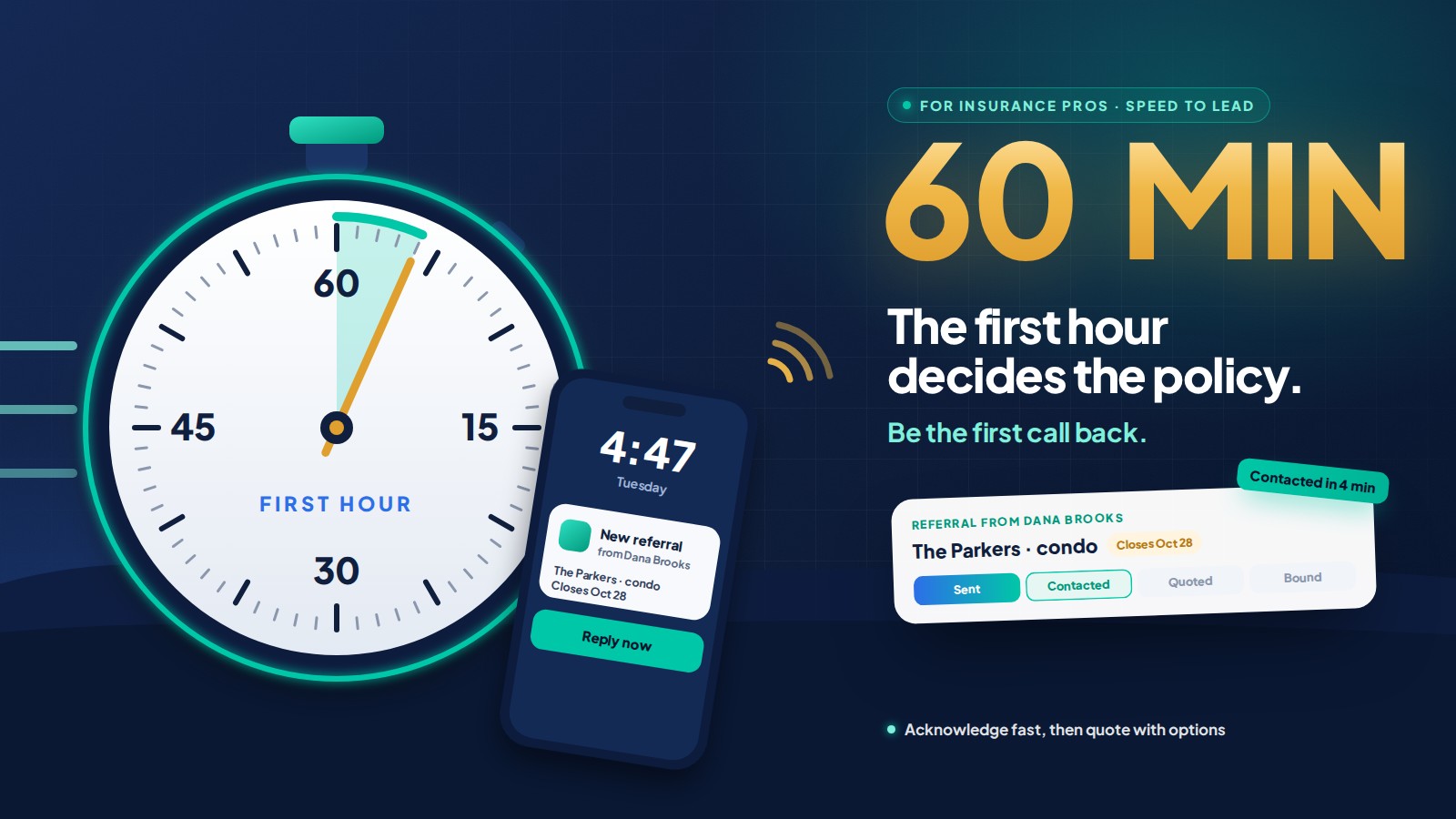
It's 4:47 on a Tuesday. You are on your third quote call of the afternoon when your phone lights up: a real estate agent you met at a closing last spring has a buyer couple, the Parkers, under contract on a condo. Closing is October 28. The lender wants proof of coverage. "Can you help them?"
You fully intend to call. You are just finishing this call first. Then one more email. Then it's 7:30, and when you finally reach the Parkers, they have already pulled two quotes online and "were just going to go with one of those."
Nobody did anything wrong. You were working. But that referral was decided in the first hour, and you weren't in it.
This is a playbook for winning that hour, without becoming someone who lives on their phone.
Why the first hour matters more than the quote
There is a well-known study in Harvard Business Review called The Short Life of Online Sales Leads. The researchers found that companies that reached out within an hour of a new inquiry were nearly seven times as likely to have a meaningful conversation as companies that waited even one more hour. That research was about web leads, which are colder than anything a real estate agent sends you. A warm referral with a closing date attached has an even shorter fuse.
The shopping data says the same thing from the customer's side. In J.D. Power's 2025 U.S. Insurance Shopping Study, the share of customers shopping their insurance jumped to 57% from 49% the year before. The 2026 edition found people now collect an average of 3.5 quotes, the most in the study's history, often straight from insurer apps. Your referred client is not waiting by the phone for you. They are comparing you to an app.
And here is the part that matters for your pipeline: the agent who sent them is watching too. According to Virginia REALTORS®' summary of NAR's 2025 Profile of Home Buyers and Sellers, 43% of buyers found their agent through a referral and another 18% went back to an agent they had used before. Real estate agents live and die on reputation. They will keep sending clients to whoever makes them look good, and quietly stop sending them to whoever leaves their client hanging.
Speed isn't about being frantic. It's about making sure the client and the agent both know, within minutes, that someone has it.
The five-move first hour
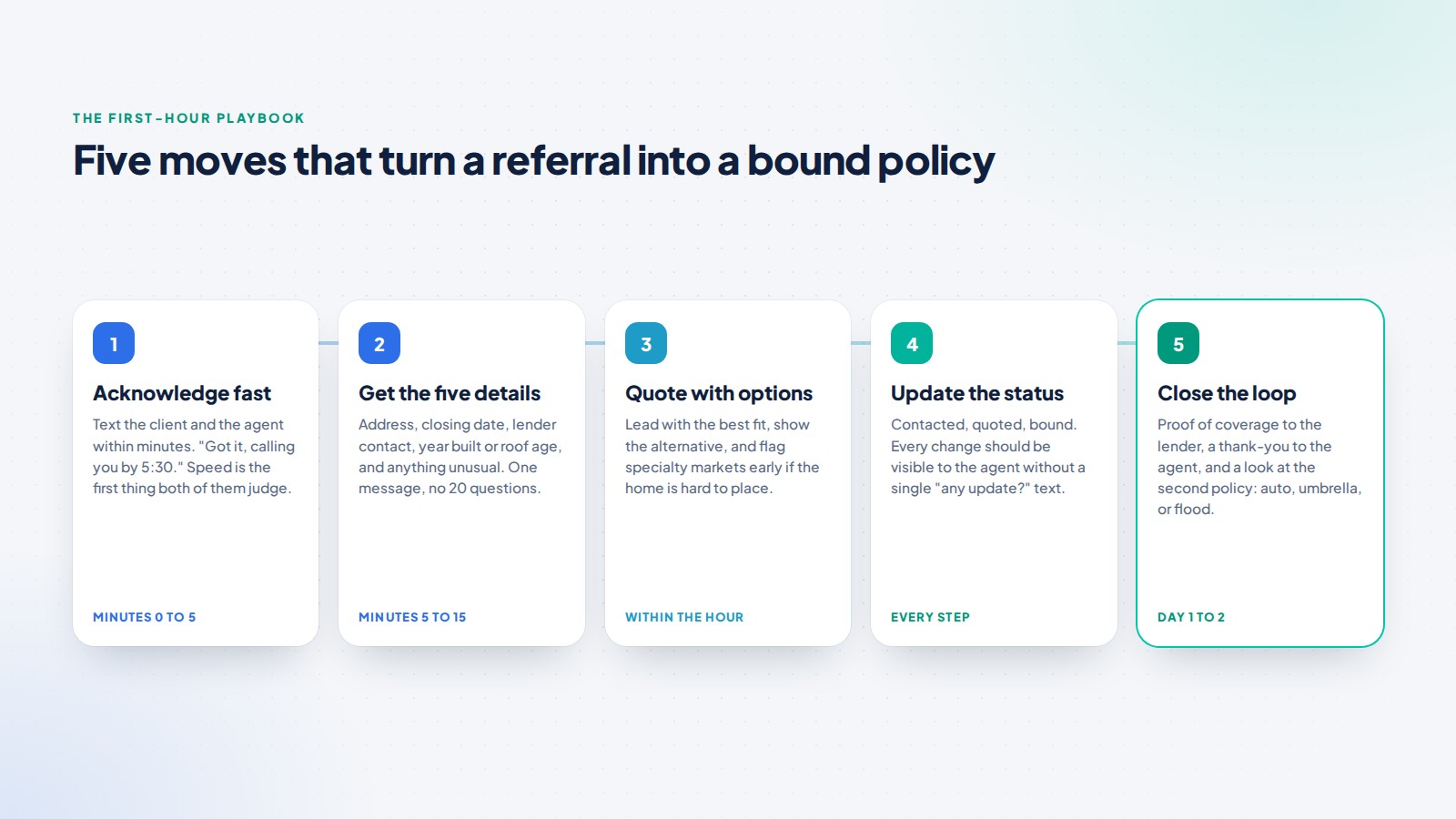
1. Acknowledge in minutes, not hours
You don't need to run the full quote right away. You need to make two people feel taken care of. Send the client a short text ("Hi, it's Maya, Jordan's insurance partner. I've got your info and I'll call you by 5:30 to get you covered for the 28th.") and let the agent know you're on it.
That one message does most of the work. The client stops shopping, the agent stops worrying, and you bought yourself 45 minutes to finish what you were doing.
2. Get the five details in one go
The slowest part of most referrals is the back and forth. Ask for everything at once, ideally from the agent, who usually has it already:
- The property address and the year it was built (or roof age, if they know it)
- The closing date
- The lender's contact
- The client's best number and when they like to be reached
- Anything unusual: a pool, a dog, a past claim, a home-based business
If you can get those up front, your first call with the client is a real conversation instead of an intake form. It's also why a Refervia handoff arrives with the client, property and closing date already attached.
3. Quote with options, and flag the hard ones early
Lead with the best fit, show one alternative, and explain the difference in plain language. If the home is older, coastal, or in a market where carriers have pulled back, say so on the first call and talk through specialty options right away. We covered why that has become so common in Deals are dying at the insurance step. Surprises are what kill closings. A heads-up on day one is what makes you the hero.
4. Make the status visible
This is the move most people skip, and it's the one agents remember. Every time the file moves (contacted, quoted, bound), the referring agent should be able to see it without texting you "any update?" A short status note is fine. A shared view they can glance at is better. Either way, the goal is that the agent never has to chase you.
5. Close the loop and look for the second policy
When the policy is bound, send proof of coverage to the lender, tell the agent it's done, and say thank you. Then, while you still have the client's attention, look at the rest of their coverage. J.D. Power's 2026 study found that among auto shoppers, 45% had a homeowners policy, but only 20% were offered a homeowners quote while they shopped. A new homeowner is the perfect moment for the reverse conversation: auto, umbrella, maybe flood. It's genuinely useful to them, and it's how one referral becomes a household. And if they need a line you don't write, hand it to an insurance partner who does and keep the relationship.
Build the habit, not the hustle
None of this requires working later. It requires a system that catches referrals the moment they arrive instead of letting them sit in a text thread next to your dentist's appointment reminder.
A few habits that help:
- Give referrals their own lane. If referrals land in the same inbox as everything else, they wait in line. Keep them somewhere you check first. If you run an agency, a shared team queue means a referral never waits on one person's inbox.
- Template your first text. The acknowledgment above takes ten seconds when it's already written.
- Set a personal rule. Something like "every referral gets a human reply within 15 minutes during business hours." Simple rules beat good intentions.
- Thank the agent publicly and specifically. "The Parkers are bound and the lender has proof. Thanks for trusting me with them." That sentence earns the next three referrals.
Where Refervia fits
We built Refervia because this exact moment kept going wrong for good people. A referral arrives as a real handoff with the client, property, closing date and notes in one place. You update the status as you work, and the agent sees it live, so they never have to ask. Your trusted agents are all in one list, and the referrals you receive are never capped on any plan. Reply fast and it shows: agents on Pro and up see a Fast Responder signal on the partners who reach out quickly.
If you are an insurance professional, start with the Refervia desk for insurance pros, or create your free account and invite the agents who already send you business. You can see how plans work for solo producers and agencies on the pricing page. Want the agent's side of this? Share our guide on building a two-deep insurance bench with the agents who send you business. Have questions first? The Refervia FAQ covers partners, plans and team queues, and Why Refervia lays out how it compares with buying leads or running referrals by text.
The first hour is going to happen with or without you. Make sure you are in it.