Every agent has a version of this Friday. Your buyers, the Nguyens, are closing next week on a 1978 ranch with an older roof. The lender emails at 3pm: still no proof of homeowners insurance. You text the insurance agent you usually send people to. No answer. You text another one you met at a networking breakfast. She's on vacation. By 6pm you're scrolling through old texts trying to remember the name of "the guy who did the Hendersons' policy."
The deal probably survives. But you just spent your Friday night doing the one job you aren't licensed to do, and your clients could hear the stress in your voice.
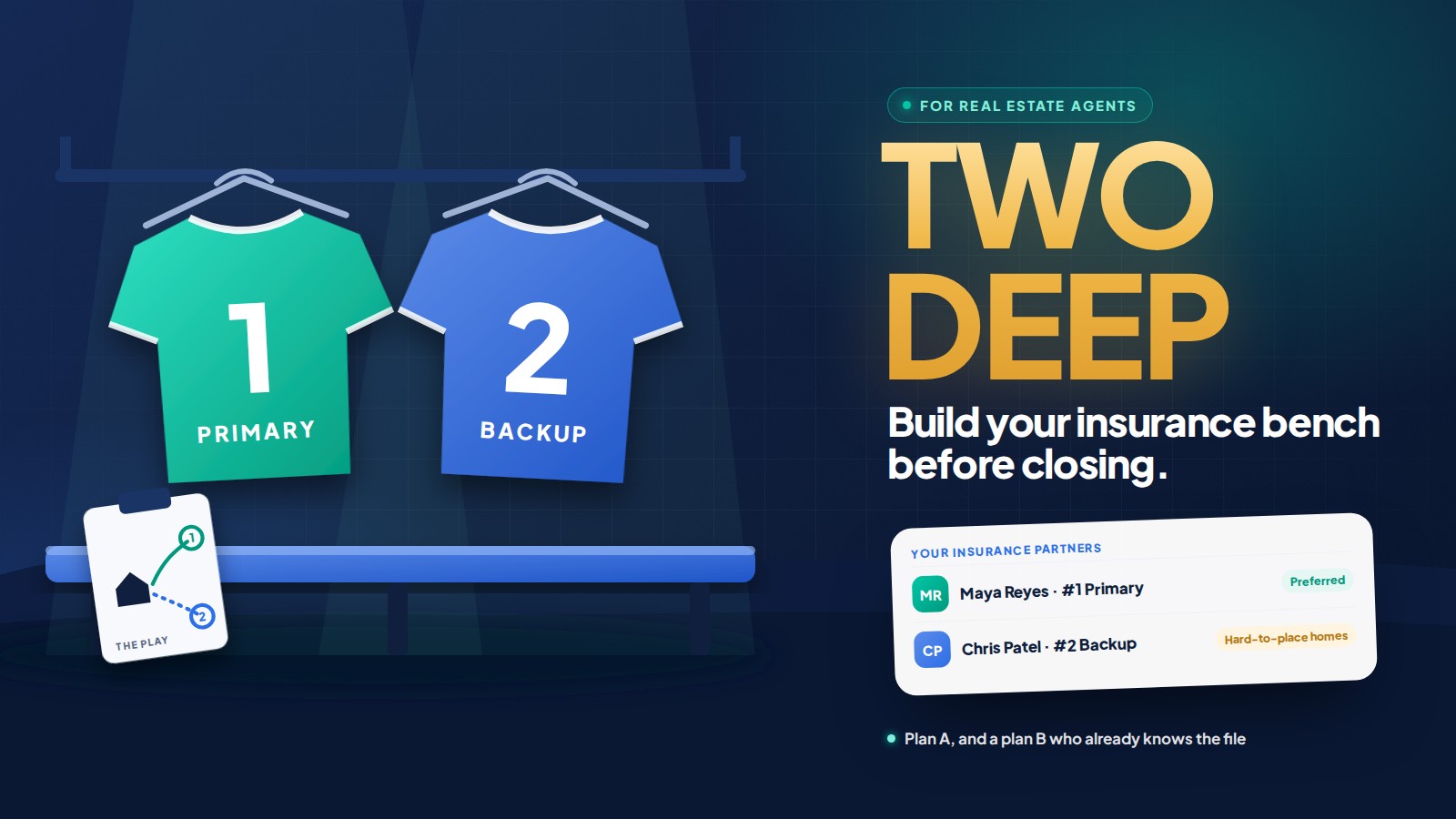
The fix isn't working harder. It's building a bench before you need it: two insurance partners you trust, set up so a handoff takes one minute instead of one evening.
Insurance is a closing requirement, not a courtesy
It's easy to treat homeowners insurance as the buyer's homework. The lender doesn't see it that way. As the Consumer Financial Protection Bureau puts it, lenders generally require proof of homeowners insurance when there's a mortgage, and its homebuying guide lists shopping for homeowners insurance as a step in getting to the closing table. No policy, no closing.
That step has also gotten harder. J.D. Power's 2025 U.S. Home Insurance Study found that 47% of homeowners insurance customers had seen a premium increase in the past year, the highest rate of insurer-initiated rate raises in more than a decade. In some states, carriers have stopped writing new policies or tightened what they'll cover, which means an older roof or a coastal address can turn a routine quote into a scramble. We dug into why in Deals are dying at the insurance step.
So the insurance step is now one of the most common places for a "done" deal to wobble. The agents who keep closing on time are the ones who already know exactly who to call, and who keep those partners in one place.
Your reputation travels with every referral
Here's the other reason to be deliberate about it. NAR's 2025 Profile of Home Buyers and Sellers shows how much of this business runs on trust. As Virginia REALTORS® summarized it, 43% of buyers found their agent through a referral and 18% reused an agent they'd worked with before, and 66% of sellers found their agent through a referral or a past relationship. NAR's own top takeaways note that 88% of buyers used an agent or broker.
When you refer your client to an insurance partner, you're lending them your reputation. If that partner is slow, confusing, or vague, your client remembers it as part of buying a house with you. If they're fast and clear, that becomes part of your story too.
You can't control the insurance market. You can control who you hand your clients to, and how well that handoff goes.
Build the bench: two deep, on purpose
Pick a primary and a backup. Your primary is the person who gets most of your referrals. Ideally they can quote more than one carrier, so a single "no" isn't the end of the road. Your backup is someone who's comfortable with harder files: older homes, coastal or wildfire areas, high-value properties. Two is the magic number. One is a single point of failure, and five is a contact list, not a bench.
Test them before your client does. Before you send a real client, send a real question: "If I had a buyer on a 1978 home with a 2011 roof closing in ten days, how would you approach it?" Pay attention to three things. How fast do they reply? Do they explain clearly or hide behind jargon? Do they ask the right follow-up questions?
Check the basics. Make sure they're licensed in your state and actively writing in your market. If they carry the Refervia Verified badge, their active license has already been checked. Ask how they like to receive referrals and how they'll keep you posted. The good ones have an answer ready.
Agree on how you'll work together. A two-minute conversation now saves hours later: "When I send you someone, can you text me when you've made contact, and again when they're bound?" Most great insurance pros will be thrilled you asked.
Hand off with context, not a text
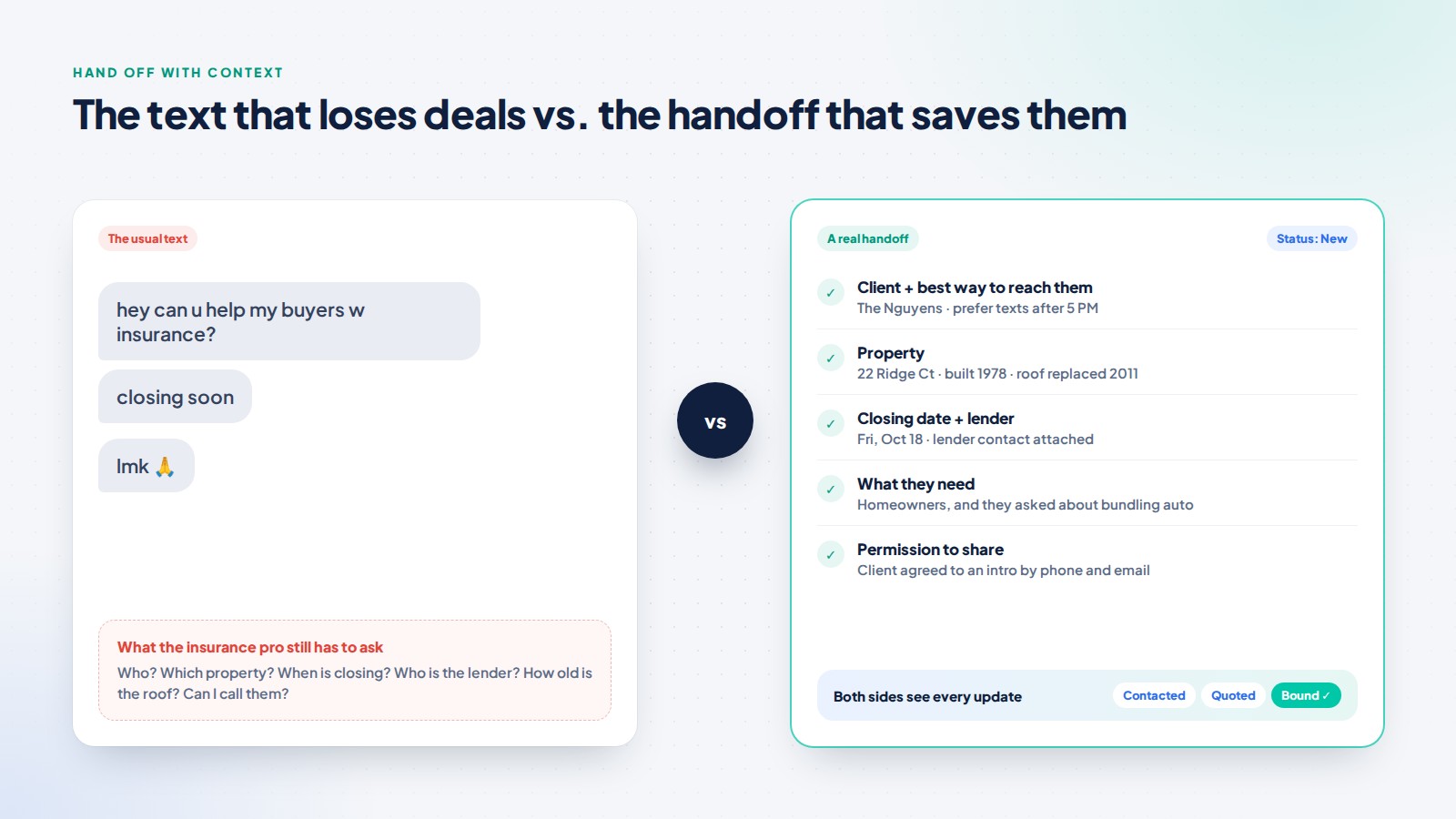
"Can u help my buyers w insurance? closing soon" isn't a referral. It's a scavenger hunt. Every question your partner has to ask you is time your client spends wondering what's happening.
A real handoff (here's how one works in Refervia) includes:
- The client and the best way and time to reach them
- The property: address, year built, roof age if you know it
- The closing date and the lender's contact
- What they need: homeowners only, or are they asking about bundling auto?
- Permission: a quick "Is it OK if I introduce you to my insurance partner?" before you share anyone's details
That's it. It takes a minute, and it lets your partner make a real first call instead of an intake call.
Keep score, and keep it human
Once your bench is working, pay attention. Who responded quickly? Whose clients thanked you afterward? Who sent business back your way? Over a year, those patterns tell you exactly who deserves your next referral.
And say thank you, both directions. A quick note when a policy gets bound ("the Nguyens are covered and the lender is happy, thank you") is how a contact becomes a partner.
Where Refervia fits
This is why we built Refervia. Your trusted insurance partners live in one list, with private labels like Preferred or Reliable that only you see. A handoff takes a minute and carries the client, property, closing date and notes in one place. Then you both see the same live status as it moves from contacted to quoted to bound, so you're never texting "any update?" on a Friday night.
If you're a real estate agent, start with the Refervia desk for real estate, or create your free account and invite the two insurance partners you'd call first. Running a team? See how a shared queue works for brokerages, and compare plans on the pricing page. Wondering how inviting a partner works? The Refervia FAQ walks through it, and Why Refervia covers the rest: private partner labels, live status, messaging and team visibility.
Build the bench before the Friday. You'll be glad it's there. And if you work with insurance pros who want to win more of your referrals, send them our first-hour playbook.