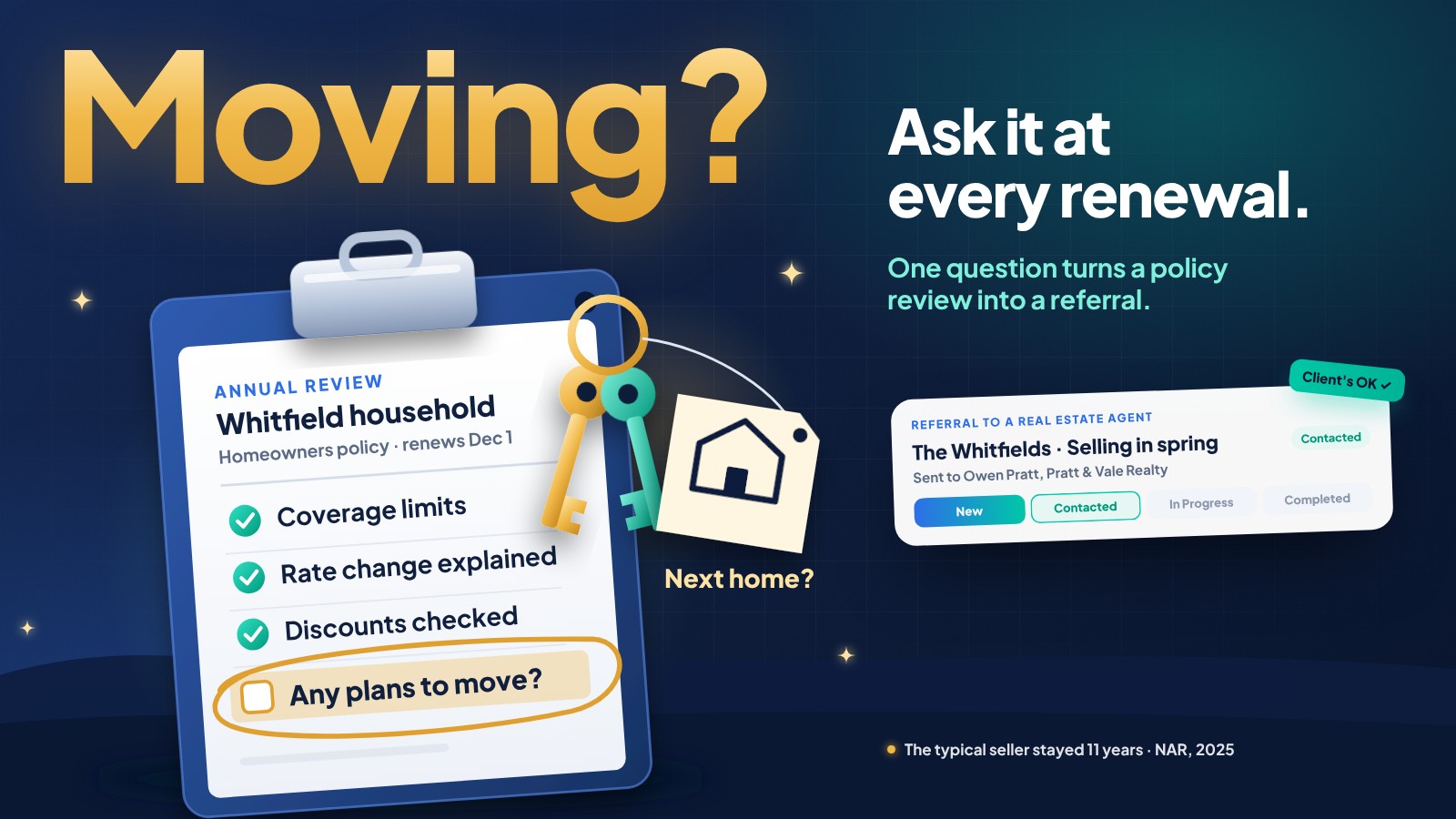
Your past clients, the Parkers, call with news. They're moving to Charlotte for a new job, and they want to buy as soon as they land. You don't work Charlotte, but you know someone who does. Before you make the intro, two questions come up: how much is the referral fee, and how does it actually get paid?
Most agents learn the answer from whoever they happen to ask first. This guide gives you the plain-English version: what's typical, how the math works, who pays whom, and what to put in writing so nobody argues about it at closing.
This is general information, not legal advice. Referral rules come from state license law, your brokerage's policies and federal law, and they differ from state to state. Check with your broker before you agree to anything.
The short answer: 20% to 35%, usually 25%
A real estate referral fee is a negotiated share of the commission the receiving agent earns on that client's deal. It isn't set by law, and there's no official standard rate.
That said, the numbers cluster. The Texas Real Estate Research Center at Texas A&M, writing about referral rules for Texas license holders, puts the typical range at 20% to 35% of the commission, and notes that the fee is fully negotiable. In practice, 25% is the figure you'll hear most often. NC REALTORS® uses a 25% fee in its own legal Q&A example about a referral dispute.
What moves the number up or down is usually the work involved. A client who is ready to buy with a pre-approval in hand is worth more to the receiving agent than a "maybe next year" lead. A luxury listing, a relocation package, or a long-standing two-way relationship between agents can all change the conversation.
How the math works

Referral fees are almost always a percentage of the receiving agent's side of the commission, not of the sale price. Here's a simple example, with made-up numbers just to show the math:
- The Parkers buy a $400,000 home in Charlotte.
- The buyer's agent side of the commission on that deal is 2.5%, or $10,000.
- The referral fee is 25% of that side: $2,500.
- The receiving brokerage keeps $7,500, and the agent gets their usual split of that.
Commission rates are negotiable and vary from deal to deal, especially since the 2024 changes to how buyer agent pay is handled. That's one more reason to write the fee as a percentage of "the commission actually received on this side" rather than as a fixed dollar amount based on a guess.
Who pays whom: broker to broker
This is the part that trips up newer agents. In most states, the receiving agent doesn't hand the fee to the referring agent. The money moves brokerage to brokerage:
- At closing, the receiving brokerage gets its commission.
- The receiving brokerage pays the referral fee to the referring agent's brokerage.
- The referring brokerage pays the referring agent their split, according to their agreement.
Texas, for example, requires that referral fees paid to sales agents go through their sponsoring broker, not directly from one agent to another. North Carolina's license rules say an affiliated broker can't be paid a commission or referral fee directly by anyone other than their current broker-in-charge (or the one they had when the deal happened).
The practical takeaway: before you promise or accept a referral fee, tell your broker and get their OK. It's their money to pay or receive first.
You need an active license to get paid
A referral fee is compensation for real estate brokerage activity, so most states only let licensed people receive it, and the license has to be active.
- North Carolina's real estate commission says plainly that an agent can't pay a referral fee to an unlicensed person or to someone whose license is inactive.
- Texas requires an active Texas license at the time the referral is made. A license holder on inactive status can't collect a referral fee for a referral made while inactive.
This is also why some agents who step back from active sales keep their license active with a referral-focused brokerage. That's usually what people mean by a "real estate referral agent": a licensed agent who sends clients to other agents instead of working the deals themselves, and collects referral fees through their broker.
What about past clients and friends? In most states you can't pay an unlicensed person a referral fee. Some states allow a small thank-you gift instead. Texas, for example, lets license holders give an unlicensed person a gift worth up to $50, and it can't be cash or a cash equivalent. Check your own state's rule before you send anything.
Why it stays between real estate agents
There's a federal piece too. The Real Estate Settlement Procedures Act (RESPA) bans paying or accepting referral fees for "settlement services" on most home loans. Its rules carve out an exemption for cooperative brokerage and referral arrangements between real estate agents and real estate brokers, which is why agent-to-agent referral fees are allowed.
The same rules define settlement services broadly. The list includes lenders and title work, and it also covers "services involving hazard, flood, or other casualty insurance." So a referral fee that's fine between two real estate agents isn't automatically fine with a lender, a title company, an inspector, or an insurance agent. State insurance rules add their own limits on paying for referrals.
The right way to build those partnerships is on trust and great service, not payments. The insurance agent who answers fast, keeps your client covered and closes the loop is the one you keep sending people to. (Here's how to build that kind of insurance bench.)
Put it in writing before the intro
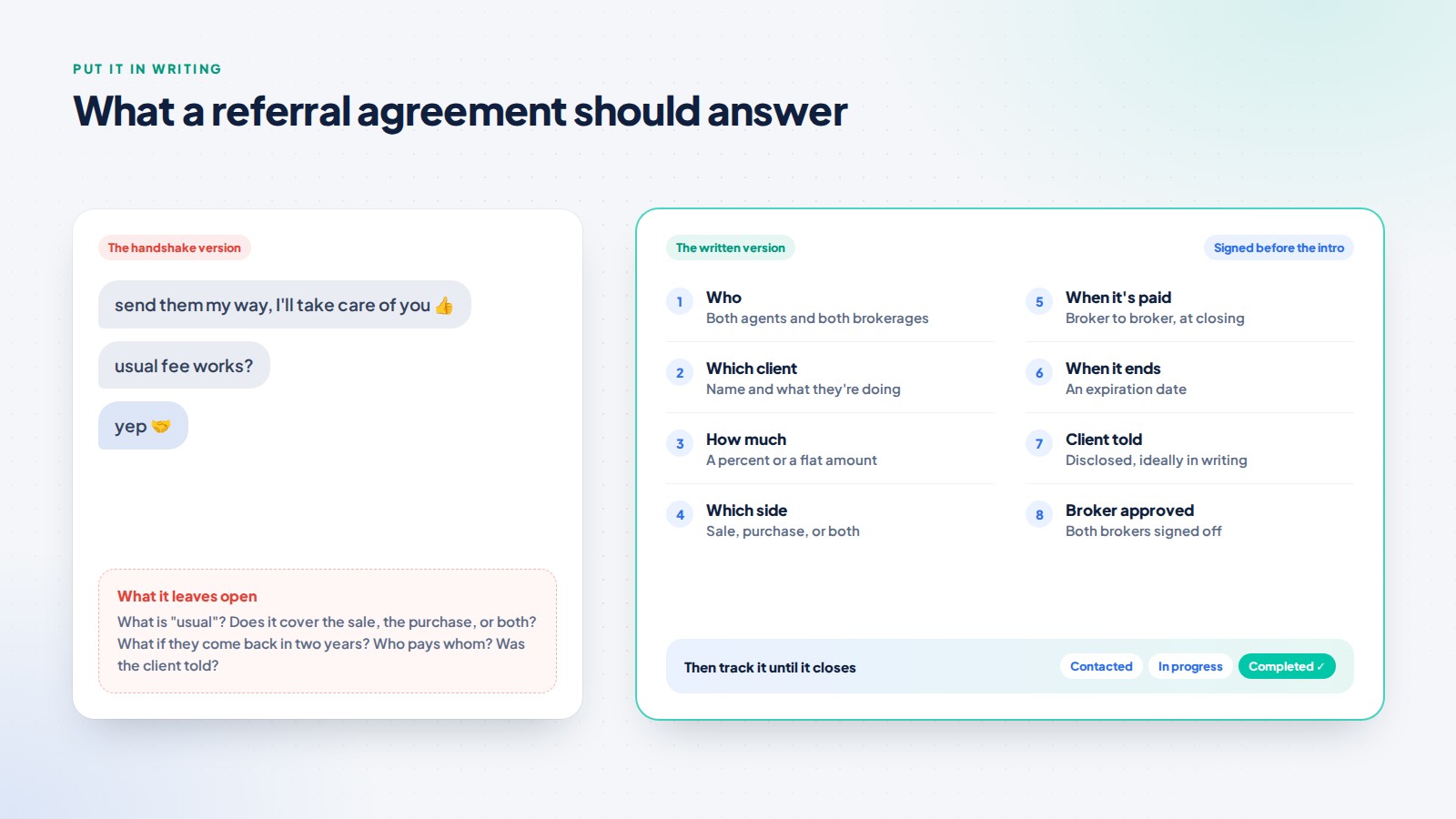
A verbal agreement can still be enforceable, but it's hard to prove what you agreed to. NC REALTORS® tells the story of an agent who agreed to a 25% fee on a listing by phone. The client pulled the listing, came back years later to list again and buy a new home, and the referring agent claimed 25% of both sides. With nothing written down, if the two agents couldn't work it out, an arbitration panel would be the one deciding what they meant.
A good written referral agreement answers eight things:
- Who: both agents and both brokerages
- Which client, and what they're doing (buying, selling, or both)
- How much: a percentage or a flat amount
- Which side it covers: the sale, the purchase, or both
- When it's paid: at closing, broker to broker
- When it ends: an expiration date, so a client who comes back in three years isn't a surprise
- Whether the client was told: some states require disclosure, and North Carolina requires the agent receiving the fee to disclose it. Texas doesn't require it between license holders, but recommends it
- Broker approval: both brokers signed off
Your state REALTOR® association or your brokerage almost certainly has a standard referral form. Use it.
Then track it until it closes
A referral fee is only paid if the deal closes, and closings can be months away. The Texas Real Estate Research Center lists "tracking the progress of the transaction" as one of the normal steps in a referral. In real life, that's the step that falls apart: the intro gets made, everyone gets busy, and six months later you're scrolling old texts trying to remember whether the Parkers ever bought.
That's the gap Refervia fills. To be clear about what it does and doesn't do: Refervia doesn't charge per-referral fees, and it never calculates, collects or pays referral fees. Your agreement and your brokers handle the money. The Refervia FAQ spells this out too. What Refervia gives you is the handoff and the paper trail:
- The client, property, timeline and your notes travel together in one handoff, so the receiving agent isn't starting from a text message.
- You both see the same live status as it moves from contacted to in progress to completed, with no "any update?" texts.
- Before every send, handoff checks show the referral-fee rules for that handoff, each with the law it comes from, and you confirm your client agreed to be referred.
- Over time, you can see which partners actually follow through, so your next referral goes to the right person.
If you send or receive referrals, start with the Refervia desk for real estate, or create your free account and invite the agents you already trust. Running a team? See how referrals route through a shared queue for brokerages. For the full picture of what Refervia does and doesn't do, read Why Refervia.
Quick answers
Is 25% the standard real estate referral fee? It's the most common figure, but there's no legal standard. The typical range is about 20% to 35%, and it's negotiable.
Is the referral fee a percentage of the sale price? Usually not. It's a percentage of the receiving agent's side of the commission.
Can I pay a referral fee directly to another agent? In most states, no. It goes from the receiving brokerage to the referring brokerage, then to the agent.
Can I pay a past client or a friend for a referral? Generally not in cash, unless they hold an active real estate license. Some states allow a small gift instead.
Can I pay a lender, title company or insurance agent for referrals, or take payment from them? Not as a referral fee. Federal RESPA rules ban referral payments for settlement services on most home loans, and those services include homeowners insurance. Talk to your broker before setting up any business arrangement with them.