In the late 1990s, researchers at Brigham and Women's Hospital in Boston surveyed doctors about referrals. The specialists said they sent their findings back to the referring doctor within a week 87% of the time. The doctors who made the referrals said they heard back within a week 36% of the time. In a follow-up on specific referrals, a quarter of the referring doctors still hadn't heard anything four weeks after their patient's visit.
Same system, two very different stories. Nobody was lazy. The specialists were busy doing good work, and they believed the update had gone out. It just hadn't landed.
If real estate agents, lenders or insurance pros send you clients, you're the specialist in that story. Somewhere, the partner who sent you their client is wondering what happened.
The quiet after the handoff
A referral partner hands you more than a phone number. They hand you a client who trusted their judgment, and with it a piece of their reputation. Then, too often, they hear nothing.
Silence after a handoff reads like nothing happened, even when you've done everything right: called the same day, quoted three options, walked the buyer through the process. Partners rarely stop sending because one client didn't work out. They stop because they don't know what happened, and the partner who does keep them posted is easier to send the next one to.
The fix is two messages: one that says thank you, and one, at each turn, that says what happened.
Message one: thank them, and be specific
In a field experiment published in 2010 and led by Wharton's Adam Grant, the director of annual giving at a public university visited one group of the university's fundraisers and said, in so many words, thank you: "I am very grateful for your hard work." A second group got no visit. The fundraisers were on a fixed salary, so extra calls earned them nothing. The week after the visit, the thanked group averaged 63 voluntary calls each, up from 41 the week before. The group that wasn't thanked went from 40 to 41.
The reason matters as much as the number. The researchers found that the thank-you worked because the fundraisers felt valued, not because they felt more skilled. A partner who feels that their referral mattered to you is more likely to send the next one.
A good thank-you is short and specific. It names the client, says what you did and says what happens next:
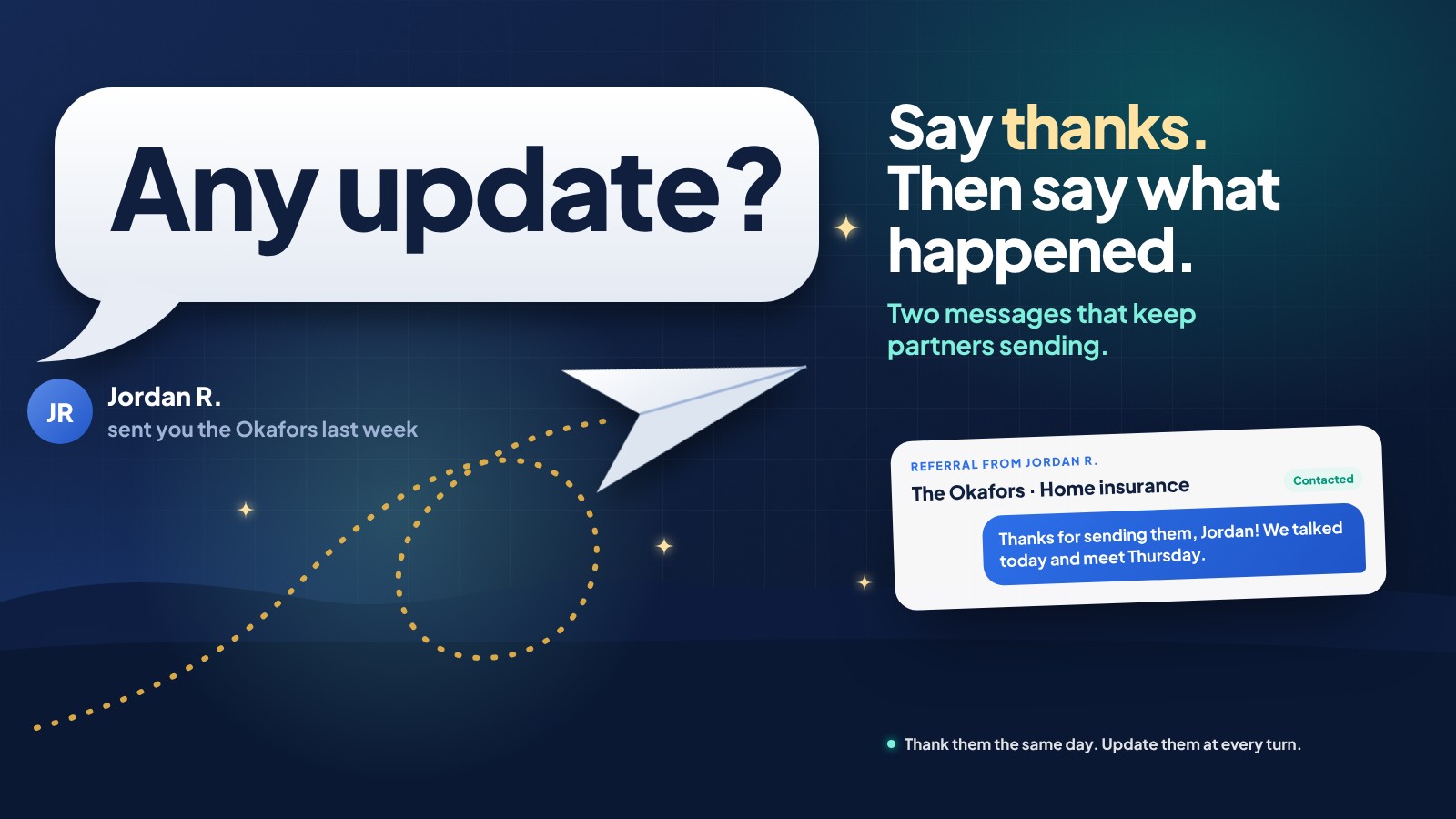
"Thanks for sending the Okafors my way, Jordan. I talked with them this afternoon, and we're meeting Thursday to go over coverage for the house on Elm Street. I'll let you know how it goes."
Send it the same day the referral arrives, even if all you've done so far is reach the client.
Keep the thanks in words. When a referral involves a settlement service on a home purchase with a federally related mortgage loan, such as the loan or title work, federal law (RESPA Section 8) bars giving or accepting anything of value for the referral, and the rule defines "thing of value" broadly, down to trips and free services. A sincere thank-you costs nothing, and it's what the research measured. Our guide to referral fees covers more of where those lines are.
Message two: say what happened, at every turn
Partners don't need a running commentary. They need to hear at the moments that matter to them and to their client:
- When you reach the client. "Talked with the Okafors today." The first update is the one partners wait for most.
- When the work is underway. The quote is out, the showing is booked, the pre-approval is in. One line is enough.
- When there's an outcome. It closed, it's on hold, or it didn't work out.
Send the bad news too. "We couldn't place coverage on that roof, so I sent them to a colleague who writes older homes" keeps a partner's trust. Three weeks of silence doesn't, even when there was nothing good to report.
If you're the one sending the referral
Closing the loop starts at the handoff. The same research paper points to earlier studies that found referring doctors who called the specialist, or sent real detail with the referral, were more likely to learn how the visit went. The same holds outside medicine. Send the client's details, timeline and what you've promised them up front, and say what update you'd like: "Can you let me know once you've talked with them?"
When a partner sends one back to you, thank them the same way. Referral partnerships that last tend to run both directions.
Where Refervia fits
Refervia makes both messages easier to send and harder to forget. Every handoff has a live status that both of you see the moment it changes, from New to Contacted to In Progress to Completed or Declined, so the update is a click you were going to make anyway. The Refervia FAQ explains what each status means, and on Pro and up you can message your partner right next to the referral, so the thank-you and the update sit with the client's details instead of in a text thread.
On Pro and up, automatic reminders nudge a partner who hasn't marked your referral Contacted after 24 hours, and tell you at 48 hours, with a quick way to send it to someone else. Over time, Partner Quality Signals like Consistent Updates and Fast Responder show who keeps you posted, and give and get shows whether referrals go both ways.
Here is what makes Refervia different. If partners already send you clients, create your free account and invite the two or three who send you the most.
Say thanks. Then say what happened. It's two messages, and it's most of what keeps a partner sending.