"Got a minute tomorrow? There's something I want to talk about."
If you run a brokerage or an agency, you know that text. By the end of the next day, one of your best people has given notice. You'll handle the listings or the book of business, the license paperwork and the goodbye lunch. What usually slips through is quieter: the lender who sends them two buyers a quarter, the insurance agent who calls them first, and the three handoffs still half-finished in their personal phone.
Those relationships are part of your firm's referral pipeline. Most owners find out how much of it lives in one person's phone on the day that person leaves.
Turnover is the normal case
This isn't a worst-case scenario. It's the math of the business.
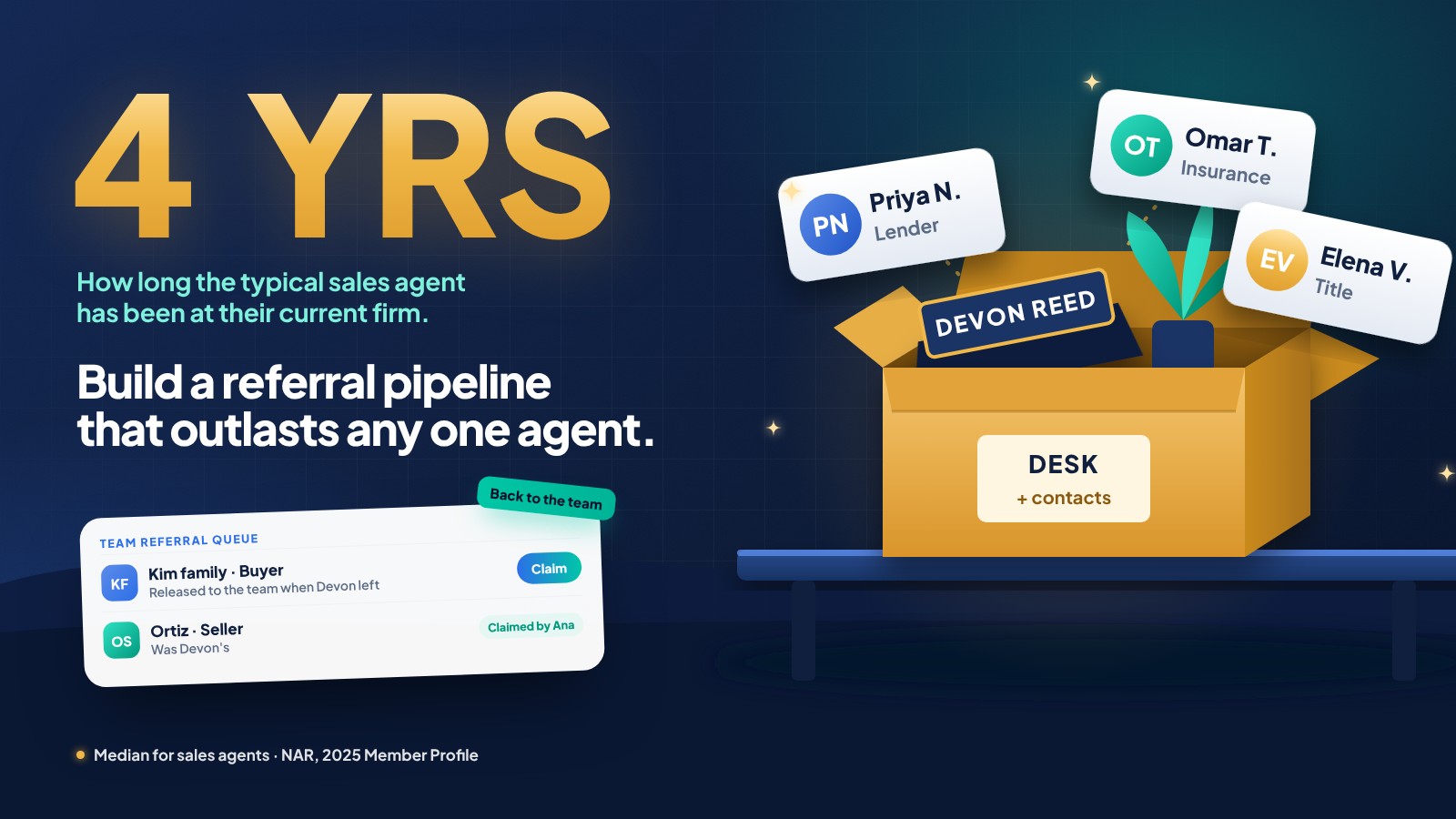
The National Association of REALTORS® 2025 Member Profile puts the typical member's time with their current firm at six years. For sales agents it's shorter: a median of four years, and 29% of sales agents had been with their current firm a year or less. The typical REALTOR® had been on their current real estate team for three years, and 9% worked for a firm that was bought or merged in the past two years.
Insurance agencies feel it from the other direction. Independent agencies typically give a new producer about three years to validate, meaning to write enough business to cover their own pay, according to the Independent Insurance Agents & Brokers of America (the Big "I"). Every producer who leaves before then takes three years of relationship-building with them, including the real estate agents and lenders who were just starting to send them clients.
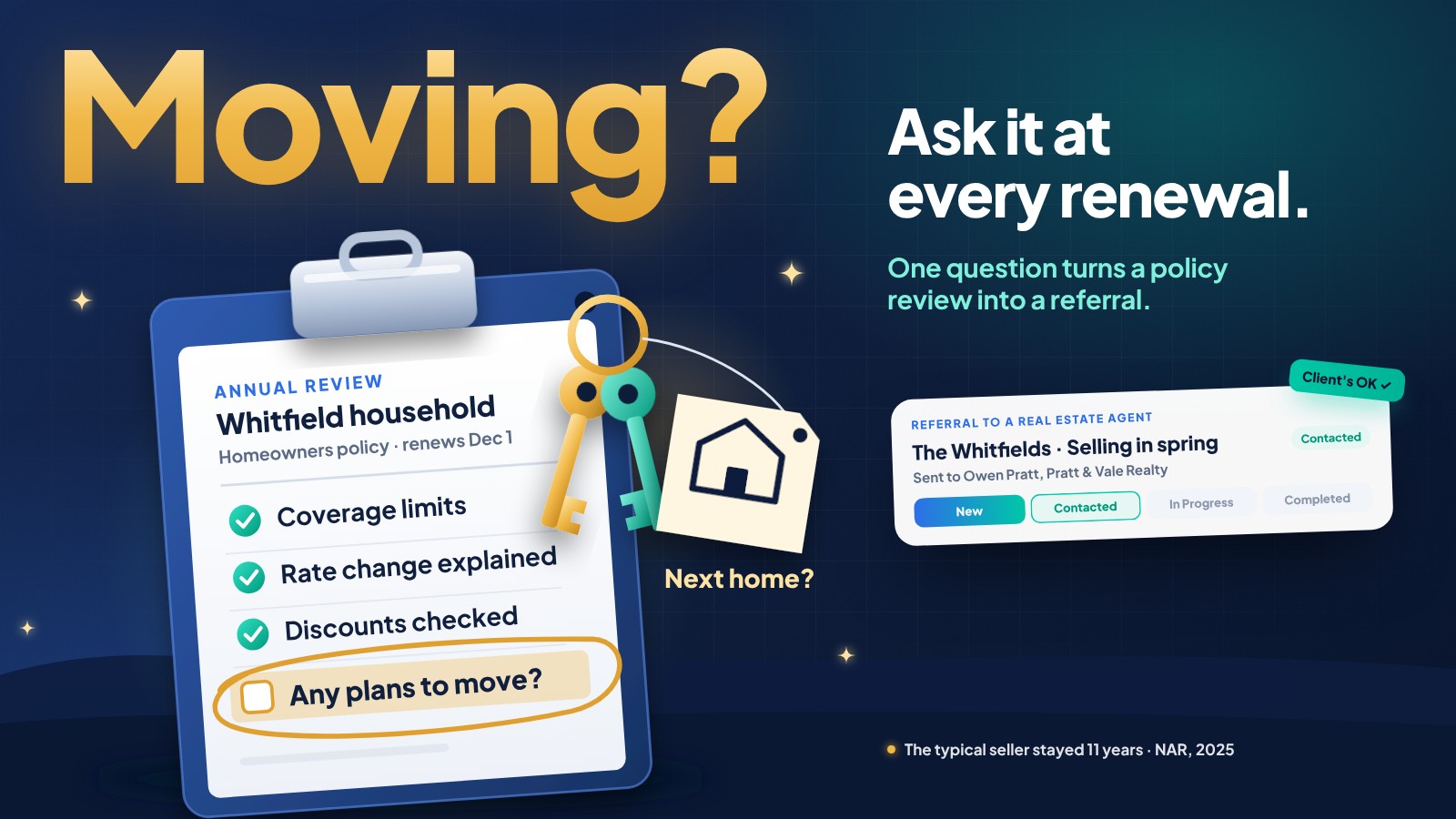
And those relationships are the business. In the same NAR report, the typical REALTOR® earned 21% of their business through referrals from past clients and customers, and another 20% from repeat clients.
A referral relationship that lives in one person's phone isn't a firm asset. It's a personal one that happens to work at your firm, for now.
Run the resignation test
Pick your busiest agent or producer. Imagine they resign tonight, and answer four questions honestly.
- Where are their open referrals? Every handoff they sent or received that isn't finished yet. Could you list them tomorrow morning?
- Who are their referral partners? The lenders, insurance pros, title reps and agents who send them clients. Does anyone else at your firm know those people by name?
- Who calls the client whose handoff was in progress? A buyer waiting on an insurance quote doesn't care about your staffing. They care about closing on time.
- What record is left? Who sent what, to whom, and what happened. Without it, you can't even thank the partners who sent the business.
If the honest answer to any of these is "in their phone," the fix is cheaper now than on the Monday after.
Four fixes that don't depend on one person
1. Route team referrals through a queue, not a personal inbox
When a referral comes into your firm for whoever is free, it shouldn't sit in one person's text messages. Post it where the whole team can see it and let the first person free claim it, so everyone can see who has it. When someone is out sick, on vacation or gone for good, the work is already visible to the people who can pick it up. We wrote about why the first hour after a referral matters; a queue is how a team protects that hour without depending on one phone.
2. Put two names on every important partner
Your best lender, title rep and insurance partners should each know two people at your firm: the agent or producer they work with day to day, and a second contact, usually a team lead or the owner. Introduce the second name for a real reason, like a quarterly check-in or a shared client, not as a takeover. It isn't about claiming anyone's partner. It's about making sure a client never waits because one person is out.
3. Decide what moves with someone before anyone moves
Who keeps which client when an agent or producer leaves is a contract question, and the answer depends on your agreements and your state. Settle it with your attorney and put it in writing while everyone is happy, not during a resignation. Whatever your agreements say, one thing never changes: a client in the middle of a handoff gets finished cleanly, with a name and a phone number they can reach.
4. Look at the pipeline every week
Once a week, look at the open handoffs by teammate, what's waiting on whom, and which partners send you the most. You'll spot single points of failure early: if every referral from your best lender goes through one agent, that's a dependency you can fix with one introduction, long before it becomes a loss.
The Monday-after checklist
When someone does leave, work through this the same week:
- Reassign their open referrals to a teammate, or put them back where the team can claim them.
- Call each partner they worked with. Thank them for the business, tell them who's covering, and make a warm introduction.
- Tell every client in the middle of a handoff who their contact is now. One sentence, the same day.
- Keep the record. What was sent, to whom, and how it turned out. It's how you'll know which partners to thank, and which ones to call next.
Where Refervia fits
This is the problem the Team Referral Queue solves. Post a referral for your whole team to claim, or assign it straight to one teammate; once someone claims it, it moves to their Referral Desk and everyone can see who has it. When an owner removes someone from the team, any queue referrals they had claimed go back to the team for a teammate to pick up, and owners and admins can reassign an open referral or send it back to the queue. On the Brokerage and Agency plans, Team Reports show every referral, what needs attention and results by teammate, with weekly and monthly report emails.
The Refervia FAQ covers how the queue works, and Why Refervia shows what makes it different from a group text or a shared spreadsheet. If you run a real estate team, see how it works for brokerages; for insurance, see it for agencies. Brokerage Free and Agency Free let up to three people try the queue at no cost: start Brokerage Free or start Agency Free, and compare every plan on the pricing page.
The best time to make your referral pipeline outlast any one person is while everyone still works there.