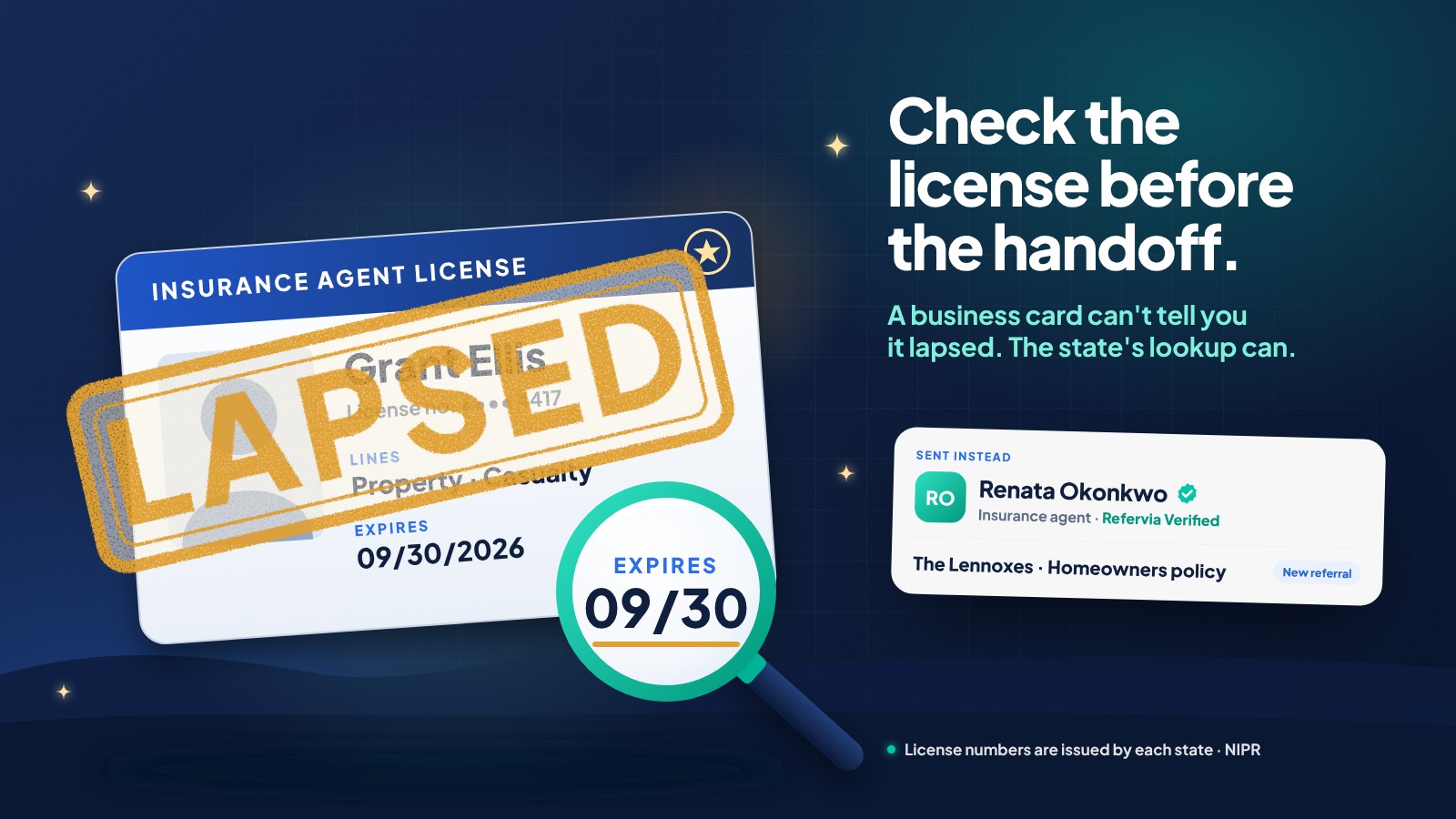
Corinne Vance has a text to the Lennoxes half typed. They close on a ranch house in Smyrna in three weeks and still need a homeowners policy, and she's about to send them Grant Ellis, an insurance agent she met at a chamber breakfast in the spring. He answers fast, he's easy to talk to, and his card says he's licensed in Georgia.
Before she hits send, she opens the state's agent search and types his name. His license expired at the end of September.
Maybe it's paperwork. Maybe a renewal is on its way. Either way, the Lennoxes can't wait to find out. Corinne sends them to Renata Okonkwo, the agent she keeps as her backup, and texts Grant: "Looked you up before sending you a client. Your Georgia license shows expired. Wanted you to know."
It took two minutes, and the Lennoxes never saw any of it.
A card says licensed. A lookup says what's true today.
A business card, a website or a confident introduction can't tell you three things about a license:
- Where. Licenses are issued state by state. NIPR, which keeps the national database of insurance producers, says it plainly: the license number comes from each state, and the National Producer Number is what ties one producer's state licenses together. A partner licensed in Georgia isn't licensed in Florida because your client is moving there.
- For what. Insurance licenses come in lines of authority. In the NAIC's model licensing law, property and casualty are their own lines, apart from life and from accident and health, and personal lines means property and casualty coverage sold to individuals and families. A great life and health agent still can't write the Lennoxes' homeowners policy.
- Still. The same model law keeps a license in effect while the renewal fee is paid and the continuing education is done by the due date. Miss it and the license lapses. Nobody reprints their cards when that happens.
Three lookups, by who you're sending to
An insurance agent
Use your state insurance department's license search. In Georgia, that's the Commissioner of Insurance and Safety Fire's agent search, which is open to anyone who wants to confirm an agent is licensed in the state. Search by name, or by license number if you have it, and check three things:
- The license is active.
- It's issued by the state where the home is.
- Its lines include property and casualty, or personal lines, for a homeowners policy.
A loan officer
Use NMLS Consumer Access, the free national search the CFPB points consumers to. Look the loan officer up by name or NMLS ID and check that they're licensed in the state where your client is buying, with the company they told you they work for. The CFPB also suggests checking with your state regulator for any disciplinary action.
You'll see that NMLS ID again. Federal rules put the loan officer's name and NMLS ID on the credit application, the Loan Estimate and Closing Disclosure, the note and the security instrument.
A real estate agent
Use the state real estate commission's license search. In Georgia, that's the Georgia Real Estate Commission's. For other states, ARELLO, the association of real estate license regulators, keeps a verification database fed by participating states, most of them daily, though not every state takes part. Check that the license is active, in the state where your client is moving, and with the brokerage the agent says they're with.
Make it a habit, not an audit
- Before the first client. The first referral is the one that tells your client how much your recommendations are worth.
- When something changes. A new company, a new state, a new name in the email signature: look again.
- Once a year for your regulars. Put it on the calendar next to your own renewal.
- Write down what you saw. "Checked Oct 26: active, Georgia, property and casualty" in your notes on that partner is enough.
When the lookup surprises you
Ask before you assume. These databases can lag: Georgia's agency search notes that its information is updated weekly and can run up to 15 days behind, and NMLS Consumer Access doesn't show an application a state hasn't approved yet. "I looked you up before sending a client and saw this. Is it current?" usually gets a quick answer, and often a thank-you.
Just don't make the client wait on the answer. Send them to a partner you've already checked, and come back to the other one when it's sorted out. That's what a two-deep bench is for.
Where Refervia fits
On Refervia, members confirm their own license to earn the Refervia Verified badge. Real estate licenses are checked live against the state licensing registry. Insurance licenses are reviewed by hand with the state, license number and NPN. Loan officers are checked by hand with their NMLS ID on NMLS Consumer Access. The badge rides along on their profile, their invites and every referral they send, and their license number is never shown publicly. The FAQ explains how verification works.
Looking for someone new near your client? The Partner Network lets you tick Verified only. The badge means the license was confirmed. For an insurance partner, still make sure they hold the lines your client needs, and that they're licensed in the state where the home is.
Here is what makes Refervia different, and every account type can start free.
Two minutes before the handoff. Your client never sees it, and that's the point.