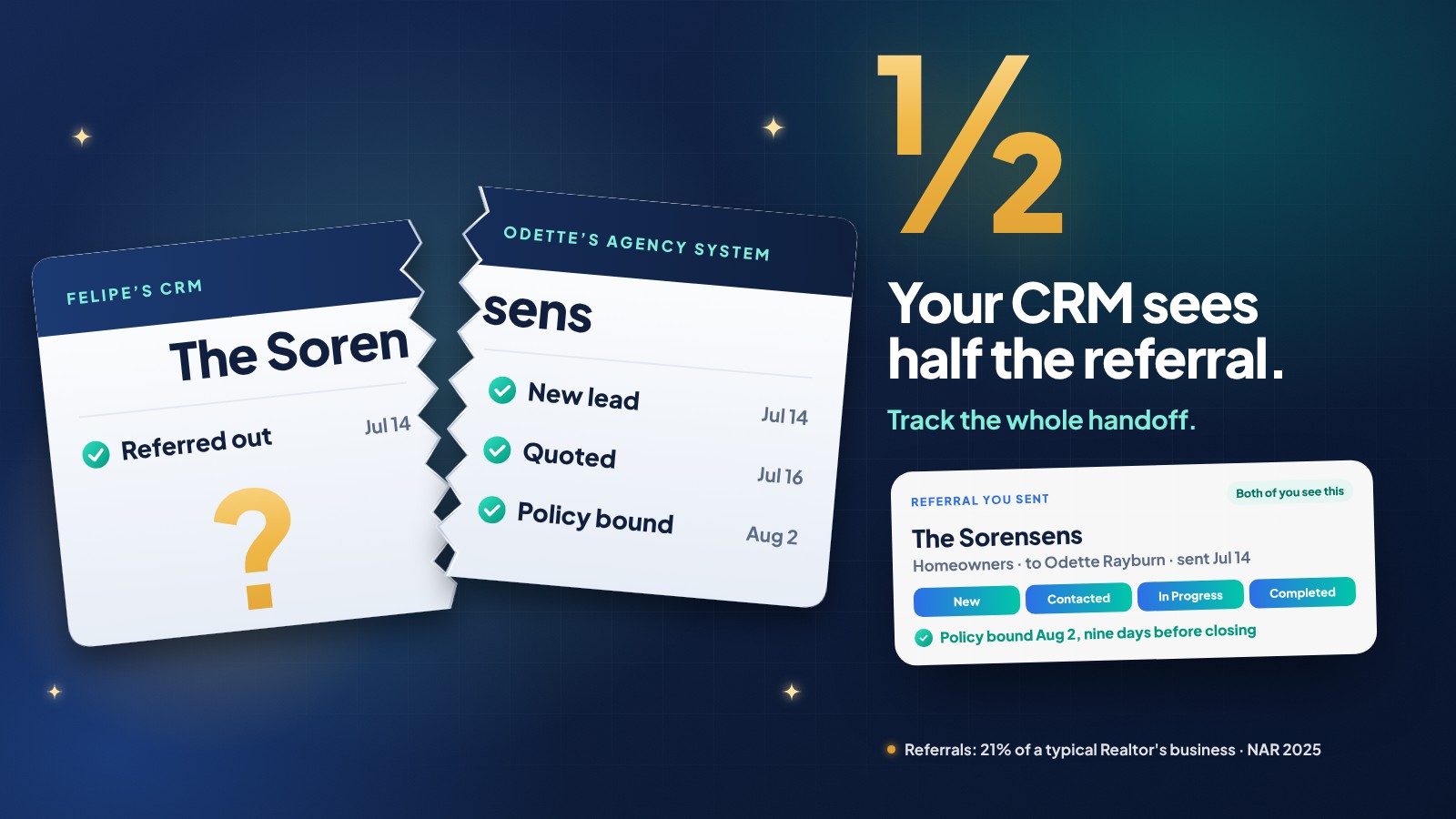
Felipe Arroyo's CRM says the Sorensens were "referred out" on July 14. That's the last line in their record. He sent them to Odette Rayburn for homeowners insurance on the townhouse they were buying in Duluth, and as far as his system knows, the story ends there.
Odette's agency system tells the rest of it. New lead, July 14. Quotes from three carriers, July 16. Policy bound August 2, nine days before closing.
Felipe hears how it went in October, from Mrs. Sorensen, at a neighborhood cookout. Nobody dropped the ball. Two good professionals each tracked their half of the referral. Nobody tracked the referral.
Two systems, one family
A CRM is built around one business. Felipe's holds his clients, his deals and his follow-ups. Odette's holds her leads, her quotes and her policies. When a client moves from one to the other, each system records its own side: an outcome on his end ("referred out") and a lead source on hers ("referral, Felipe"). Everything in between, whether she reached them, whether they're quoting, whether it bound, lives in a text thread if it lives anywhere.
That's a big blind spot for something this important. NAR's 2025 Member Profile found the typical Realtor got 21 percent of their business through referrals from past clients, and another 20 percent from repeat clients. In NAR's 2025 Profile of Home Buyers and Sellers, 43 percent of buyers found their agent through a friend, neighbor or relative, and 7 percent were referred by another real estate agent or broker. On the insurance side, 58 percent of the policyholders in Vertafore's 2025 survey were referred to their independent agent by family or friends.
Each side tracks the business that referrals bring in, in detail. The handoff between them is the part almost nobody tracks.
Four things every referral record needs
Tracking a referral well doesn't take much. It takes the same few facts, in one place both of you can see:
- Who, and when. Who sent it and who received it, by name and business, and the date it went over.
- The client, and their OK. Who the client is, how to reach them, and when they agreed to be introduced.
- Where it stands. One status word that both of you use the same way.
- What's next, and by when. The next step and the date it's due, so a quiet week shows up as a quiet week instead of a surprise in October.
Agree on what the words mean
Status is where shared tracking quietly falls apart. To one agent, "contacted" means a voicemail. To another, it means a real conversation about coverage. Pick a short set and define each status by something that happened, not by how the deal feels:
- New: sent, and nobody has reached the client yet.
- Contacted: your partner and the client have actually talked.
- In progress: real work is happening, like quotes, showings or an application.
- Completed or declined: it finished, or your partner couldn't take it, with one line saying why.
Then agree on the finish line, because it isn't the same for every partner. When a real estate agent sends a buyer to an insurance agent, completed usually means the policy is bound before closing. Sent to a lender, it might mean clear to close. Sent to another agent across the state, it means the closing itself. Say which one you mean, once, and the word stops causing arguments.
Start with a shared sheet
If you trade a handful of referrals a year with one partner, a shared spreadsheet is a fine place to start. Give the four things above their own columns, share the sheet, and both of you keep it current. It costs nothing, and it beats scrolling back through a text thread.
It also breaks in predictable ways as the referrals add up:
- Nobody hears about it when a row sits on New for a week.
- Your partner updates their own system first, and your sheet second, or not at all.
- Every new partner means another sheet, or one big sheet everyone can edit.
- When someone types over a cell, the history is gone.
When those show up, you've outgrown the sheet. That's usually when people start searching for referral tracking software.
What to look for in referral tracking software
Plenty of software "tracks referrals" in the sense of recording where a lead came from. That's one field on one side's record. For referrals between professionals, look for a tool built around the handoff itself:
- One record, both sides. The sender and the receiver work from the same referral, not two copies that drift apart.
- Reminders when a referral sits. If it's still New the next day, somebody should hear about it without having to remember to check.
- A history of every change. Who moved it, to what and when, kept after it closes.
- It works with your CRM. New referrals should land in the system you already use, so you don't have to give that system up.
Then ask one question the feature list won't answer: who touches the money? Referral fees come with their own rules (here's how they work in real estate), and a tool that tracks the handoff has no reason to be anywhere near them.
Where Refervia fits
Refervia is built around the handoff, not the lead. When Felipe sends the Sorensens from his Referral Desk, the referral lands on Odette's desk as New, and from then on they're both looking at the same record. When she marks it Contacted, then In Progress, Felipe sees each change as it happens, and each status means the same thing to both of them (the FAQ spells them out).
On Pro and up, automatic reminders do the checking for you: a referral still New 24 hours after you sent it gets a reminder to your partner, and at 48 hours you get No contact yet, with a quick way to send it to someone else. The client status link lets the Sorensens see where their referral stands without calling Felipe to ask.
It doesn't ask you to give up your CRM. Connect it once and new referrals flow into it through Zapier, or export a CSV anytime (how it works with your CRM). And it never touches the money: Refervia doesn't charge, collect or split referral fees, and the FAQ says so plainly. Here is what makes Refervia different, and you can create your Referral Desk free.
Your CRM will always see your half. Make sure somebody can see the whole referral.