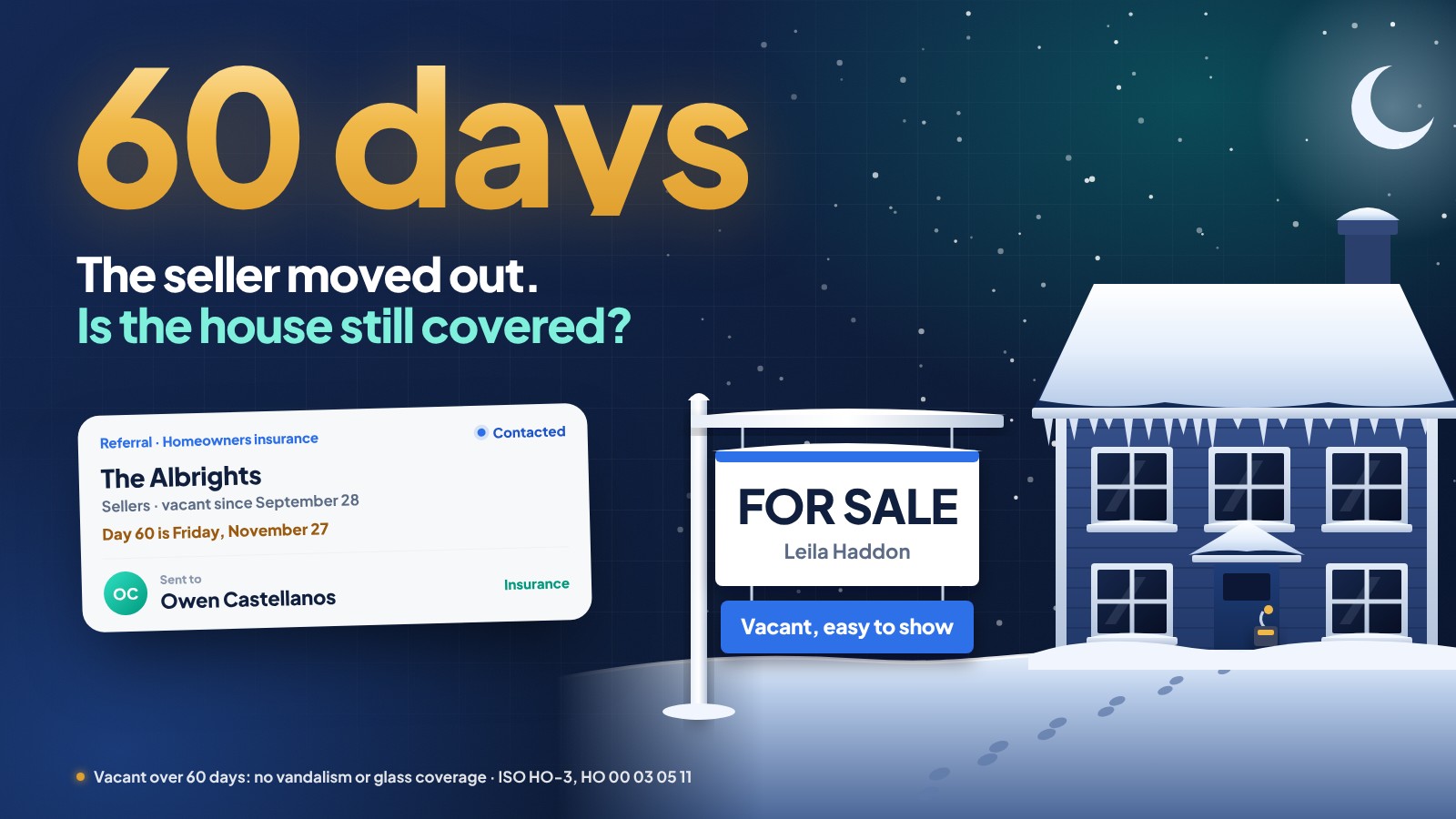
Leila Haddon's newest listing is the Albrights' house. They moved to Charlotte for a new job on Monday, September 28, and took everything with them. The rooms are bare, the lockbox is on the front door, and the sign in the yard has the rider every buyer's agent likes to see: Vacant, easy to show.
Here's the date nobody wrote down. If the house is still empty on Friday, November 27, the day after Thanksgiving, it will have been vacant for 60 days. On the standard homeowners form many policies are built from, that's when part of the coverage stops. And the risk that matters most in an empty house in winter has no grace period at all.
Fixing the policy isn't the listing agent's job. Asking about it is, because the listing agent is often the only professional who knows the house is empty.
Two lines in the policy decide a winter claim
Many homeowners policies are built on the HO-3, the Homeowners 3 Special Form from the Insurance Services Office (ISO). Two of its lines matter for an empty house.
The 60-day line. Once the dwelling "has been vacant for more than 60 consecutive days immediately before the loss," the HO-3 stops covering vandalism and malicious mischief, along with "any ensuing loss" from what the vandal did, and it stops covering broken glass. If someone breaks in on day 61 and leaves a tap running, the water damage goes out with the vandalism. Earlier editions of the form used 30 days, and some carriers' own forms still do, so the number that counts is the one in the seller's policy.
The freezing line. This one has no day count. The HO-3 doesn't cover freezing of plumbing, heating, air conditioning, a sprinkler system or an appliance, or the water that leaks out because of it, unless the owner used reasonable care to "maintain heat in the building" or to "shut off the water supply and drain all systems and appliances of water." Day 5 and day 95 are judged the same way: was the heat kept on, or was the house drained?
One more question belongs to the seller's insurance agent. The HO-3 covers the "residence premises," which the form defines as the dwelling "where you reside." Whether a house the owners have left for good still fits that definition depends on the policy and the state. That's for the agent to answer, not for anyone else to guess.
Vacant and unoccupied aren't the same word
To an insurer, a vacant house is generally empty of people and of the things someone would need to live there. A house with the furniture still in it and nobody living there is usually unoccupied instead, and a policy can treat the two differently. A lightly staged house sits somewhere in between. That's exactly why the seller should ask their agent which one their house is, and get the answer in writing, before it matters.
Why winter makes this urgent
About one in 60 insured homes has a property damage claim for water damage or freezing each year, and those claims averaged $15,400 from 2019 to 2023, according to the Insurance Information Institute. State Farm alone received more than 20,000 frozen-pipe and winter water claims from 2024 through June 2025 and paid out over $628 million, an average of more than $30,000 a claim. Two of its top five states for losses were Texas and Tennessee, so this isn't only a northern problem.
State Farm says pipes in attics, crawl spaces and outside walls are most at risk below 20 degrees, and a small crack can let out more than 250 gallons of water a day. In a house where someone lives, that's a bad morning. In an empty one, nobody hears it until the next showing.
Three questions for the listing appointment
Ask these when you take the listing, and again if the plan changes:
- Will anyone be living here while it's listed? If not, write down the move-out date.
- When is day 60? Count it from the move-out date and put it on your calendar. If the seller's policy says 30, count that too.
- Who's your insurance agent, and do they know the house will be empty? Most sellers haven't told them. If they don't have one they trust, offer to introduce yours.
Then put the heating plan in the showing instructions, so every agent who walks through keeps it working. The American Red Cross says to leave the heat at no lower than 55 degrees when you're away in cold weather, and to open the cabinet doors under the sinks so warm air reaches the pipes. A line like "Vacant: heat stays on, please don't set the thermostat below 55" costs nothing.
What the insurance agent can do before day 60
The seller's insurance agent is the one who can actually close the gap, usually in one call:
- Read the policy's own words on vacancy, unoccupancy and freezing, since carriers change the standard form.
- Ask about a vacancy permit endorsement, which keeps the coverage the vacancy rules would take away for a set period, usually for an extra premium, or about a policy written for a vacant home.
- Agree on heat or drain. Either the heat stays on and someone checks the house on a schedule, or a plumber shuts off the water and drains the lines. Ask which one this policy treats as reasonable care.
- Keep a record. A dated photo of the thermostat at each visit, or the plumber's invoice for draining the lines, is how the seller shows they took reasonable care.
Where Refervia fits
When Leila takes the listing, she sends the Albrights to Owen Castellanos, her Trusted Partner for homeowners insurance, as a referral in Refervia. The notes say "vacant since September 28" and "day 60 is Friday, November 27," and she sets a follow-up date for the Monday before Thanksgiving. When Owen reaches the Albrights, he marks it Contacted, and Leila can see where it stands without asking.
If Owen hasn't marked it Contacted a day later, Refervia's automatic reminders nudge him on Pro and up, and at 48 hours Leila hears "No contact yet," with a quick way to send it to someone else. The FAQ explains how the reminders work, and here's what makes Refervia different from a text you hope gets read. If you don't have an insurance partner yet, start with a two-deep insurance bench.
Policies differ by carrier and by state, so the seller's own insurance agent has the final word on their coverage.