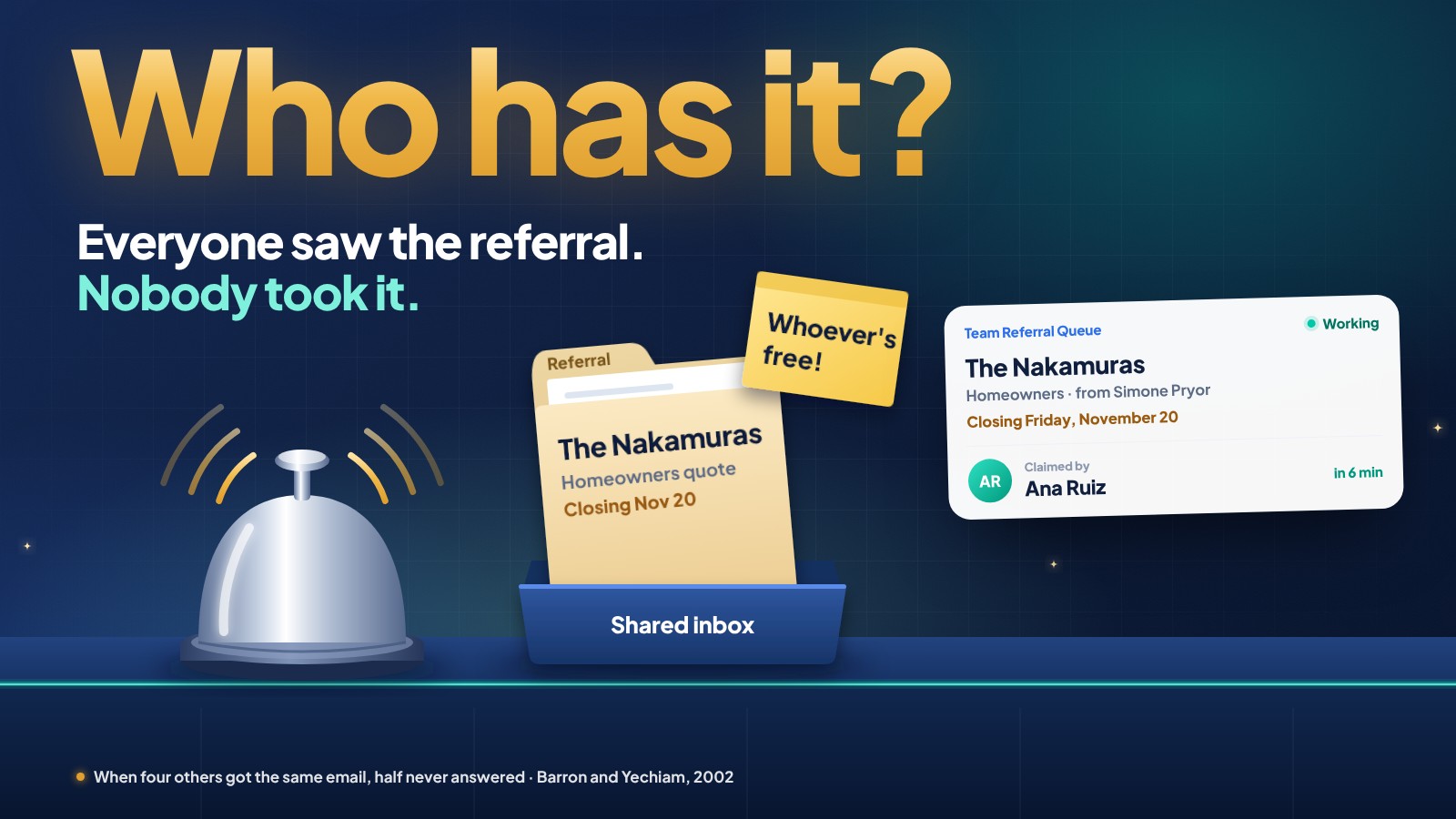
At 4:52 on a Friday, Simone Pryor sends a referral to an insurance agency she trusts. The Nakamuras are closing on Friday, November 20, and need a homeowners quote. Her email goes to the agency's shared inbox, and it ends the way referrals to a team often do: "whoever's free."
Five producers can see that inbox. Three of them open the email before six. Each one figures someone else has it.
On Monday morning, Simone texts the owner: "Did anyone reach the Nakamuras?" Nobody had. By then the Nakamuras had called the agent their lender mentioned, and the policy was bound somewhere else.
Nobody at that agency was careless. The referral never had an owner, and a message the whole team can see is the easiest kind to leave for someone else.
A message to everyone reads like someone else's job
Psychologists call it diffusion of responsibility. In a classic 1968 experiment, students who believed they were the only one hearing a fellow student's seizure over an intercom went for help before the intercom cut off 85% of the time. When they believed four others were listening too, 31% did.
Email works the same way. Researchers at the Technion sent a simple question to 240 people, each either alone on the To line or with four others. Half of the people who saw four other addresses never answered; of those who got it alone, 36% didn't. In a 2005 study, people told that 14 or 49 others had the same request replied 14% of the time, against 36% when they were alone or with one other person.
The same research points to the fix. In a 2000 study of online chat groups, help came more slowly as the group grew, until the person asking used one member's name. Then the effect all but disappeared.
Why a few minutes decide a team referral
A referred client doesn't wait while your team works out who's up. In NAR's 2025 Profile of Home Buyers and Sellers, 74% of buyers interviewed only one agent before choosing, and 80% of sellers contacted only one. For a brokerage, a referral that sits over a weekend can end up with whichever agent the client reaches first. For an agency, a buyer with a closing date on the calendar needs a quote while there's still time to bind it.
Four ways to route a referral
Every team routes referrals somehow, even if the rule is "whoever sees it." These are the four real choices, and most teams mix them.
Take turns
The next name on the list gets the next referral. It's fair and easy to explain. It breaks on the day the person who's up is at a closing, on vacation or slow to answer, because now the referral waits on one person's day. If you take turns, skip anyone who's out, and give the person who's up a short window to accept before it moves to the next name.
First one free claims it
The referral goes to the whole team at once, and the first person who's free claims it. The claim is the part a shared inbox is missing: the moment someone takes it, everyone sees their name. It's usually the fastest of the four. It breaks when the same two people claim everything, or when nobody's free at 4:52 on a Friday, so someone has to watch for the referrals nobody has claimed.
Send it to the specialist
Commercial lines go to the producer who writes commercial. A Spanish-speaking family goes to the agent who speaks Spanish. A relocation buyer goes to whoever knows that side of town. It's the best fit for the client, and it breaks when the specialist is the bottleneck. Name a backup for every specialty.
Honor the partner's pick
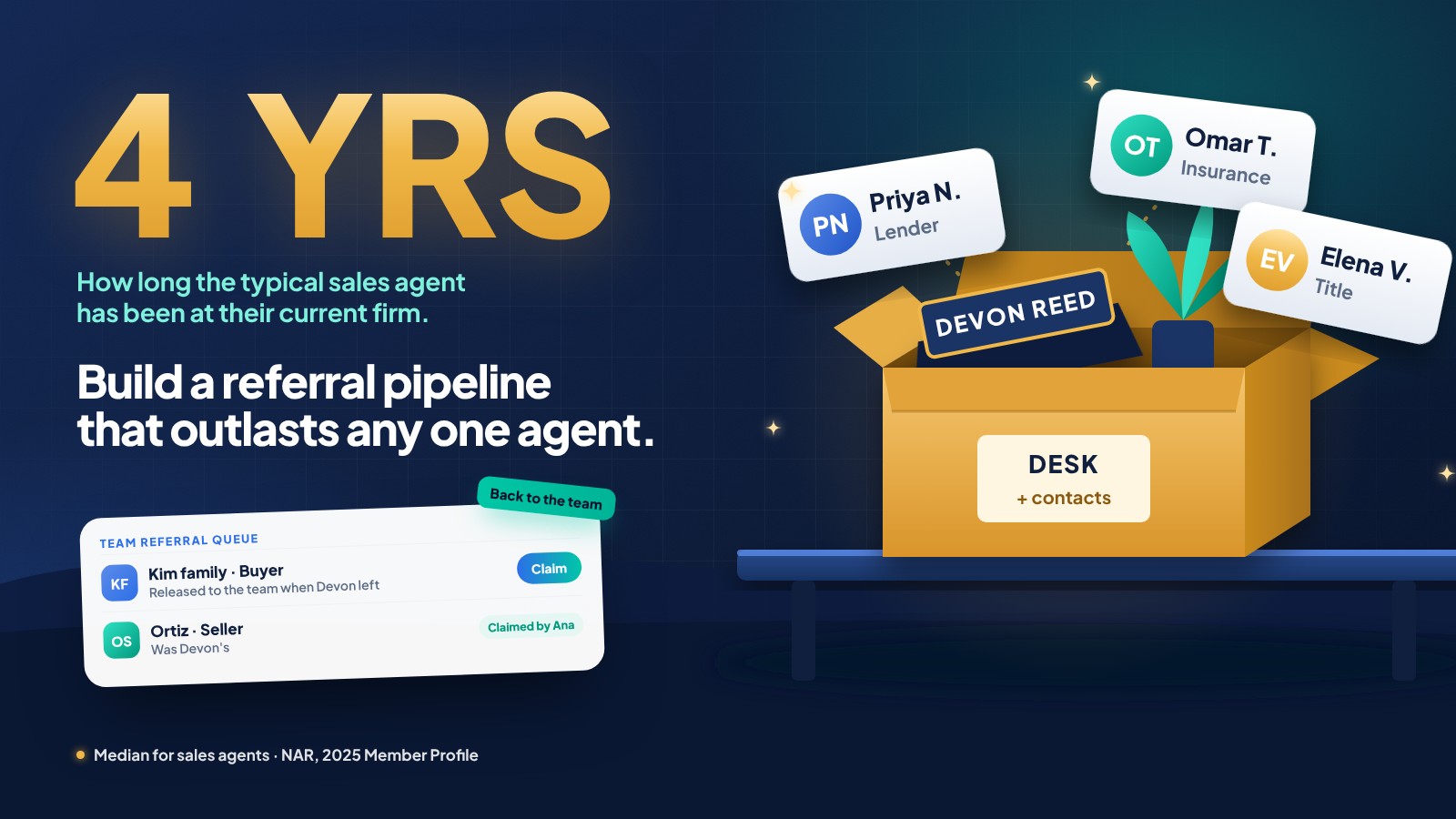
When a partner asks for someone by name, that person gets it. Referral relationships are personal, and a lender who always works with Ana should reach Ana. It breaks when Ana is out, or gone, and nobody else can see her work. Keep every referral where the owner can see it, whoever it went to. On the day someone leaves, that's the difference between a handoff and a scramble, and it's the first step to a referral pipeline that outlasts any one agent.
A common mix: the partner's pick first, the specialist second, and first one free for everything else.
Four rules that make any of them work
- Put one name on every referral, fast. Pick a window, like 15 minutes during business hours, and write it down. Anything still unclaimed when it closes gets assigned by the owner or a manager, by name.
- Tell the sender who has it. "Ana Ruiz has the Nakamuras and will call them this afternoon." One sentence the same day keeps the partner calm, and an update at every turn keeps them sending.
- Out means out. A closing, a vacation or a sick day takes that person out of the rotation until they're back.
- Look at it every week. How long referrals waited for a name, how long until the client heard from someone, who carried the load and what closed.
Run the 4:52 test
Before you change anything, find out what happens today. Ask a partner you trust, or a teammate from another office, to send your team a referral marked TEST the way partners usually do: the shared inbox, the main line or a text to whoever they know. Use a teammate's phone number for the "client." Then write down three times: when someone took it, when the client got a call, and when the sender heard who had it.
If the answer to any of the three is "when somebody asked," your routing has a gap. Now you know where it is.
Where Refervia fits
This is the job of the Team Referral Queue. Post a referral for the whole team to claim, or assign it to one teammate. The first one free clicks Claim, the referral moves to their Referral Desk, the owner is notified, and everyone can see who has it. Owners and admins can reassign a referral or send it back to the queue, and paid team plans can auto-assign by line of business.
On Brokerage, Agency and Enterprise, your team can also have its own referral link. Partners send through one link, and the referral lands in the queue for the first teammate free. A referral sent through a teammate's own link arrives already assigned to them, so the owner still sees every one. On those plans, Team Reports show speed-to-lead week by week.
The FAQ covers how claiming works, and here's what makes Refervia different from a shared inbox or a group text. Insurance agencies and real estate brokerages can see it all on the page for teams and book a free demo. Brokerage Free and Agency Free let up to three people try the queue at no cost.