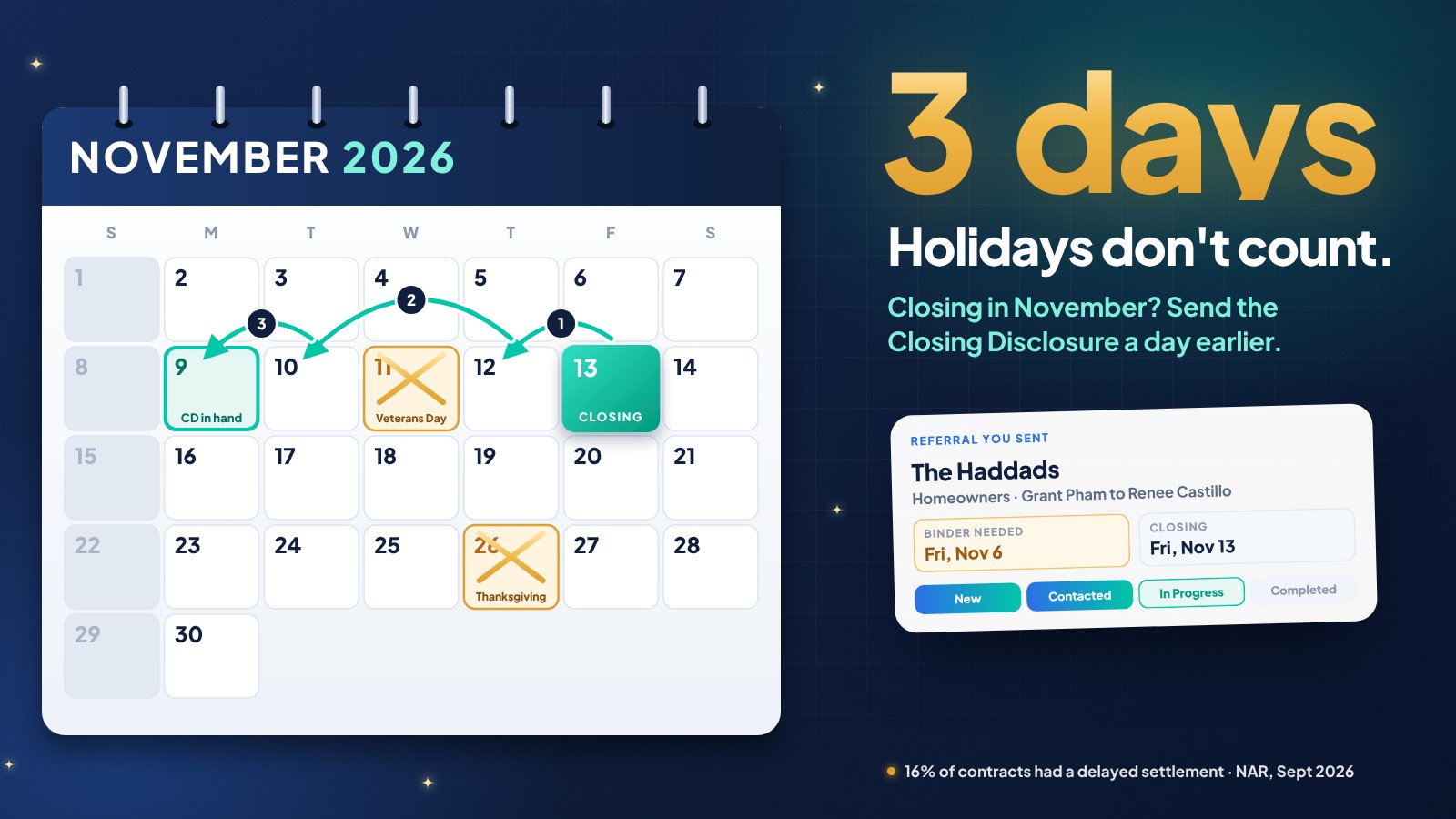
Grant Pham had the Haddads' Closing Disclosure set to go out on Tuesday, November 10, the way it goes out for every Friday closing. Their agent, Marisol Vega, had already told them the movers could come Saturday. Then, the Thursday before, Grant's processor looked at the calendar. Wednesday, November 11, is Veterans Day, and for the Closing Disclosure's three-day rule, a federal holiday isn't a business day. Received on Tuesday, the earliest the Haddads could sign was Saturday.
So the Closing Disclosure moved to Monday, and the homeowners policy had to be bound before the weekend, because the premium and its escrow go on the Closing Disclosure. Grant called the Haddads' insurance agent, Renee Castillo, before he called anyone else, and the binder was in on Friday. The Haddads had the Closing Disclosure by Monday lunch, and Friday's closing held. One date moved by a day, and three professionals heard about it in time.
November has two of those weeks, and the cost of missing one is real. In NAR's REALTORS® Confidence Index for September 2026, 16 percent of contracts had a delayed settlement over the prior three months, while the typical contract closed in 30 days.
The rule, without the jargon
Federal rules give the buyer time to read the final numbers before signing. Four things decide when the Closing Disclosure has to go out:
- Three business days. The buyer must receive the Closing Disclosure at least three business days before closing.
- What counts as a business day. For this rule, every day counts except Sundays and federal holidays. Saturdays count. Veterans Day and Thanksgiving Day don't.
- Sent isn't received. If the lender emails or mails it and can't show when the buyer got it, the rule treats it as received three business days after it went out. A confirmed receipt the same day keeps the clock honest.
- Some changes restart the clock. If the APR becomes inaccurate, the loan product changes or a prepayment penalty is added after the first Closing Disclosure, the buyer needs a corrected one three business days before closing. Most other changes can be corrected at closing.
This is general information, not legal advice. The lender's compliance team makes the final count for any loan.
November's math, closing by closing
Count back three business days from the closing, skip every Sunday and every federal holiday, and that's the latest day the buyer can have the Closing Disclosure in hand. In the weeks of Veterans Day and Thanksgiving, the date lands a day earlier than usual:
- Closing Thursday, November 12: in hand by Saturday, November 7. In a normal week, Monday.
- Closing Friday, November 13: by Monday, November 9. Normally Tuesday.
- Closing Friday, November 27: by Monday, November 23. Normally Tuesday.
- Closing Monday, November 30: by Wednesday, November 25. Normally Thursday, which this year is Thanksgiving.
December repeats the pattern. Christmas falls on Friday, December 25, so a Monday, December 28 closing needs the Closing Disclosure in hand by Wednesday, December 23.
Who needs which date
A closing date touches at least four people, and each one needs a different date from it:
- The agent needs the Closing Disclosure date before promising a closing day, a moving truck or a final walk-through.
- The loan officer works back from the closing to the Closing Disclosure, then tells the agent and the insurance agent what that means for them.
- The insurance agent needs the date the policy has to be bound. Lenders ask for proof of homeowners insurance, and the first year's premium is commonly paid at closing, so the policy has to be in place before the final numbers are.
- The buyer needs to know the Closing Disclosure is coming, open it the day it arrives and confirm they received it.
When everyone hears the dates on the first day, a holiday is a calendar detail. When they hear on Tuesday afternoon, it's a lost weekend and a rebooked truck.
Put the dates in the handoff, not in a text
The dates go missing at the handoffs. An agent refers a buyer to a loan officer with a contract date in an email. The loan officer refers the same buyer to an insurance agent with a quick text that says "need a binder soon." By Thanksgiving week, three people are working from three different calendars.
Two habits fix most of it. Put the closing date and the binder date in the referral itself, where both sides can see them. And know who covers when your partner is out for the holiday: an insurance agent on vacation the week of Thanksgiving is exactly why a two-deep insurance bench exists. When the referral lands, the first hour is when the dates get confirmed, and one shared record keeps them from drifting.
Where Refervia fits
Refervia carries the dates with the handoff. A loan officer's referral form includes the buyer's pre-approval and the date the insurance binder is needed (the FAQ for loan officers has the details), and both sides see the same live status on the Referral Desk. On Pro and up, automatic reminders nudge a partner who hasn't marked a referral Contacted, and the client status link shows the buyer where their referral stands without a phone call. Refervia doesn't send Closing Disclosures or replace a lender's systems. It makes sure the people around the closing are working from the same dates.
Here's what makes Refervia different. Loan officers can start on the Refervia page for lenders, and agents on the real estate desk. Create your free account before the holiday weeks start.